Consciouscarma
  • Home
  • About Us
  • Products
  • Community
    • Campaigns
    • Inspiration
    • Initiatives
    • CSR
  • Features
    • Sustainable Startup Stories
    • Travel
    • Lifestyle
    • Partners
  • Economy
    • Industry
    • Innovations
    • National
    • Global
  • Environment
  • Expert Corner
    • Authored Articles
    • Reports
  • Magazine
  • Contact
Category:

Expert Corner

vedic civilisation
Authored ArticlesExpert Corner

Vedic Civilisation is the most advanced Civilisation across time

by Team Conscious Carma July 6, 2021
written by Team Conscious Carma

Every Vedic practice and concept is rooted in science and reason

Creation is not linear; it is cyclical in nature. There is childbirth and death and rebirth. Sun rises and sets to rise again. Seed gives rise to a tree that produces more seeds for more trees to grow. Moon follows a cycle, so does water. The cyclical pattern is seen in human evolution too. Lighter thoughts, thoughts for creation and selfless actions make one rise and heavier thoughts, asuric disposition put one on the descending cycle. The extent, to which one rises or falls depends on the influence of asurs and devas in his/her life. Asuric shaktis pave way for disruption of various aspects of creation, daivik shaktis aid growth and development.

Ravan, for example, ascended to become one of the greatest pandits of all times who extemporaneously created the Shiv Tandav Stotram, to perfect which calls for sadhna of many years together. Ravan could do this owing to the strong influence of devik shaktis on him. But as asuric shaktis took over, he started disturbing the rishis and munis, and so his descend began.

In economics, it is said that a company whose graph is horizontal, that is, where there is no upturn or downturn, that company would shut down in a short while. Even a downturn is considered a growth factor. This law is constant in all aspects of creation. It is also applicable to yogis and to huge empires. Upturn and downturn cycles are very important for growth. With every downturn, one must use its momentum to reach a new high.

Saffron has been worn by rishis and munis for thousands of years and for thousands of years it has been attacked by the asurs. We all know of Lord Ram who went to defend the yagya of Rishi Vishvamitra against the attack of asurs. Yagyas create positivity and asurs thrive on negativity.

In today’s world, the increasing influence of asuric forces can be traced back to the beginning of invasions by nomadic tribes of the Arabian Peninsula and tribes from the far reach of Europe. Take, for example, the Portuguese invasion of the West coast of India in the sixteenth century that brought in its wake large-scale destruction of the temples, burning of ancient scriptures as well as disbanding of yagyas and other spiritual practices in the region or the invasions by Ghori and Ghazni. Mahmud of Ghazni destroyed thousands of temples during his raids including the Somnath temple in 1025AD, killing over 50000 people who tried to defend it. In the early years of British penetration in India, there was an uprising of the saints termed as the Sanyasi Revolt. British fearing the power of these men in saffron and knowing that they would not be able to establish their rule in India till these people are suppressed, killed 150 saints.

In present times, the term ‘saffronisation’ has been coined by negative, asuric forces to uproot the vedic culture and undermine the saints. Corrupt so-called saints are highlighted in the media repeatedly to pull down the image of saffron, while hardly ever is a saint working for animals or people or environment brought to fore. Our country is known to produce saints like Ramkrishna Paramhans, Ramana Maharishi and their modern counterparts, but no one talks about them. No one even talks about so-called saints from any other community, when many are known to have committed crimes against humanity. I wonder why the media handpicks only a specific few.

In such times it becomes our prime duty to uphold saffron, by understanding what it is all about, by understanding the Vedas and what they talk about and not a myopic opinion based on a minority highlighted in the media.

Vedic civilisation is perhaps the most advanced civilisations across time. The kind of knowledge and understanding of various aspects of creation that was possessed by the Vedic seers and is documented at length in ancient texts is unmatched till date. While the rest of the world was inhabited by barbarics as per modern historians, Vedic masters were dispelling the gyan of Shanti (peace), preservation and protection of nature and its resources, compassion to animals and envisioning universes and galaxies far and beyond.

Slowly and gradually modern science is progressing, only to appreciate and validate the Vedic concepts and way of life. This is to say, that every Vedic practice and concept is rooted in science and reason, some modern science agrees with present times, for some others it needs to further develop to understand. This is the heritage of Bharatvarsha, the phenomenal power of saffron and Vedas. Let us not encourage asurik shaktis in bringing down this glorious culture. Let us delve deeper into our ancient sciences, the Vedas and revive them for the benefit of mankind, for an ascend.

To quote from Rigveda, “Sun moves in its orbit which itself is moving. Earth and other bodies move around the sun due to the force of attraction, because the sun is heavier than them.” (RV 1.164.13) “The moving moon always receives a ray of light from the sun.” – (RV 1.84.15). In the 5th century itself, Aryabhatt knew that the earth revolves around the sun, is spherical in shape, rotates on its axis, and is suspended in space. He understood the laws of gravity, the circumference of the earth, the distance between the planets and the sun, the revolutionary movement of the earth around the sun, and so on. At least 1100 years before Galileo and Newton, Aryabhatt wrote in his Aryabhateeyam, “Just as a person travelling in a boat feels that the trees on the banks are moving, people on the earth feel that the sun is moving.”


July 6, 2021 0 comment
0 FacebookTwitterPinterestEmail
beauty industry oriflame products
Authored ArticlesExpert Corner

The environmental impact of the beauty industry

by Team Conscious Carma June 7, 2021
written by Team Conscious Carma

The world over, beauty standards have changed drastically over the past few years. As millennials and GenZ consumers enter the consumer bracket, there is a rising demand for transparency when it comes to the environmental impact of beauty products. As the detrimental effects of rampant deforestation, oceanic pollution and global warming come to the fore, beaubrands are also taking conscious steps towards reducing the impact on nature and its vast bounty. 

New-age consumers are looking for beauty brands that do not contribute to environmental degradation through toxic ingredients, ingredients from endangered sources, cutting of trees for their packaging. In fact, buzzwords like natural extracts, organic, ethically sourced, and environment friendly are of the utmost importance to today’s consumers. Therefore, brands, too, are increasing their efforts towards achieving the highest levels of sustainability. 

Climate protection 

Many sectors in the industry are introspecting their role in climate change. To reduce or offset the impact on climate, brands must relook and change their processes including manufacturing at factories, to packaging their products, to delivering their products to consumers. Leading brands such as Oriflame are using renewable energy at manufacturing facilities, renewable electricity sources across offices, etc can, for instance, as a great first step towards protecting the environment. This can also be done by installing solar panels at factories and manufacturing units to reduce the dependence on non-renewable resources. 

Since CO2 emissions contribute a great deal towards climate change, brands can also reduce their dependence on traditional logistics and switch to environment-friendly logistics options when it comes to transportation of their products between facilities or to consumers. Through careful consideration and well thought through changes, the impact of the beauty industry on the climate can be reduced by a great margin. 

Moreover, Oriflame has planted 6 million trees and protected them in reforestation projects. In doing so, the brand is reducing CO2 emissions while allowing individuals to breathe in fresh air. 

Keeping the oceans clean 

Most beauty brands across the globe, thus far, used harmful plastic microbeads in their scrub and harmful chemicals in their foaming products which would end up in the oceans, deeply harming marine biodiversity. Maintaining the balance of the oceanic ecosystem is crucial for sustaining human life as well. 

Considering this reality, new-age beauty brands such as Oriflame are putting a halt to such harmful practices by using 100% natural origin exfoliants like almond shells, fruit seeds in their scrub products and bio-degradable formulations in rinse-off products to ensure that everything that ends up in the ocean is broken down safely and naturally.  

Reducing the use of water at manufacturing units, and collecting rainwater are also great ways to save precious water. Furthermore, Oriflame’s wellness factory in India reuses 100% of its water.

Conserving forests 

In the past, brands used palm oil in their products which led to deforestation. Further, trees were also cut down to prepare packaging, catalogues, etc. The harsh truth is that, according to the World Wildlife Fund, we are losing around 18.7 million acres of forests annually to deforestation. Addressing this problem, brands like Oriflame use 99% of their paper, board packaging and catalogues from credible, certified sources or recycled materials. 

It is not an overstatement to say that natural is the veritable future of the beauty industry. For brands that have understood the need of the hour, there is no looking back. Only sustainable brands that check their impact on nature will be able to survive today’s competitive market that is dominated by consumer’s demand for environmentally sustainable products. Natural extracts, organic ingredients, ethically sourced and overall responsible beauty will be the mainstay of this industry going forward. Humans and the planet will reap the benefits for decades to come. 

Naveen Anand, Senior Director, Regional Marketing-South Asia at Oriflame

DISCLAIMER: The views expressed are solely of the author and CONSCIOUS CARMA does not necessarily subscribe to it. CONSCIOUS CARMA will not be responsible for any damage caused to any person or organisation directly or indirectly.

June 7, 2021 0 comment
0 FacebookTwitterPinterestEmail
Authored ArticlesExpert Corner

Carbon Explained: All You Need To Know About Carbon Dioxide

by Team Conscious Carma May 22, 2021
written by Team Conscious Carma

By Avely Pütsep

We live on a carbon planet and we are carbon life.

Carbon is all around us. It’s in diamonds, fruits, people, plants, and graphite. It’s in the coffee you drink and the candles you burn. It’s easier to list things that lack carbon, like gold fillings in teeth and silicon microchips in phones.

First, are carbon and carbon dioxide the same thing? 

Well, no. 

In the context of climate change, “carbon” is commonly used as a shorthand for carbon dioxide which in actuality is not the same thing. 

What is carbon?

Carbon is a chemical element like oxygen, lead, or any other in the periodic table. Carbon is the 6th element. 

There are a few types of atoms that can

  • be a part of a plant one day, a part of an animal the next, and then travel in air or downstream as a part of a river,
  • = recycle the same atoms over and over again.

Carbon fiber is a long chain of bonded carbon atoms. The fibers are extremely stiff, strong, and light, and are used in many processes to create excellent building materials.

What is carbon dioxide?

Carbon dioxide, or CO2, is the most commonly produced greenhouse gas, which traps heat in the atmosphere. A simple definition of carbon dioxide is when each atom of carbon joins with two atoms of oxygen. Hence the name CO2. 

However, in the context of atmospheric CO2, carbon and carbon dioxide are often used interchangeably. They are both correct but keep in mind that one tonne of pure carbon equals 3.67 tonnes of CO2.

Is carbon dioxide good or bad? That’s too simplistic a question. Yes, it causes climate change but the importance of carbon can’t be overlooked.

trees taking carbon dioxide

Why is carbon important? 

This question concerns the role of carbon dioxide in the atmosphere. Carbon is the central element in compounds necessary for life: organic compounds. These little fellas make up everything from cells to structures of organisms. They also carry out life processes. 

Carbon is the most important element to living things because it forms many different kinds of bonds and forms essential compounds.

Without carbon, life as we know it literally wouldn’t exist. ????????

A few more reasons why carbon is necessary and, let’s face it, awesome:

  • Carbon regulates the Earth’s temperature
  • Carbon provides a major source of energy to fuel our global economy
  • Carbon is required to form complex molecules like proteins and DNA
  • Your skin, hair, blood, bone, muscle, and sinews all depend on carbon

How does carbon dioxide get into the atmosphere?

There are two main sources of CO2: natural and human activities. 

Human activities play a massive role, having increased atmospheric CO2 concentration by 47% since the Industrial Revolution began.

Examples of human sources of carbon: 

  • CO2 emissions from fossil fuels, burned to generate 85% of electricity globally
  • transportation, which is the second biggest source of CO2 emissions in the US
  • land-use change like clearing of land for agriculture to raise livestock
  • extensive deforestation: trees are potent organisms for absorbing and removing CO2 emissions from the air, helping to provide a carbon neutral planet. Cutting them down stops that process.

The planet’s carbon footprint is rapidly rising. It’s considerably higher than at any point in the last 800 000 years.

Natural activities include everything that happens in – you guessed it – nature. 

Examples of natural sources of carbon dioxide:

  • organisms dying
  • volcanoes erupting
  • fires blazing
  • fossil fuels burning

In oceans, carbon continually moves through surface water and the atmosphere, or it’s stored for a long time in the depths of oceans. 

Marine organisms from marsh plants to fish, seaweed to birds, also produce carbon through living and dying. Like people. 

Most animals exhale carbon dioxide as a waste product. Including people.

carbon

Where is carbon dioxide found?

Carbon can be found everywhere, really. Most is stored in rocks and sediments. 80% of it is locked in rocks as inorganic carbon in the earth’s crust and mantle or lithosphere. Carbon is also in the ocean, atmosphere, and living organisms. And these are reservoirs of carbon, AKA carbon sinks! 

What is a carbon sink?

A carbon sink is a place that absorbs more carbon than it releases. 

One of the biggest carbon sinks are forests, which continually take carbon out of the atmosphere through the process of photosynthesis. That’s why it’s so important to protect the forests we have left. The older the tree, the greater its potential to store and offset carbon, and slow climate change. 

Oceans are also carbon sinks. They store a large amount of carbon dioxide by absorbing it from the atmosphere.

About the author:

Avely Pütsep is an environmentalist by heart and her big goal is to open complex topics (from carbon to bitcoin) so everyone understands them. She’s a writer/marketer at a fintech startup saving the world and travels the globe full-time to gather inspiration and stories.

About Single.Earth:

Single.Earth is an initiative to save the world. It’s not just big words, but an actual impact. Single.Earth is a fintech startup offering a unique natural capital marketplace. They use blockchain technology, big data analysis, and satellite imagery to show the world’s natural resources and allow landowners to earn money from their land without logging, deforestation, or putting in mines.

May 22, 2021 0 comment
0 FacebookTwitterPinterestEmail
Authored ArticlesExpert Corner

Climate Literacy is a core pillar to Restore Our Earth

by Team Conscious Carma May 16, 2021
written by Team Conscious Carma

Climate and environmental literacy is a core pillar of Earth Day 2021’s Restore Our Earth theme. We can’t expect to solve the climate crisis if we don’t learn about it. We need to understand how anthropogenic activities affect the environment and how the environment affects us.

A climate-literate person

  • understands the essential principles of Earth’s climate system,
  • knows how to assess scientifically credible information about climate,
  • communicates about climate and climate change in a meaningful way, and
  • is able to make informed and responsible decisions with regard to actions that may affect climate.

WHY DOES CLIMATE SCIENCE LITERACY MATTER?

During the 20th century, Earth’s globally averaged surface temperature rose by approximately 1.08°F (0.6°C). Additional warming of more than 0.25°F (0.14°C) has been measured since 2000. Though the total increase may seem small, it likely represents an extraordinarily rapid rate of change compared to changes in the previous 10,000 years.

Over the 21st century, climate scientists expect Earth’s temperature to continue increasing, very likely more than it did during the 20th century. Two anticipated results are rising global sea level and increasing frequency and intensity of heatwaves, droughts, and floods. These changes will affect almost every aspect of human society, including economic prosperity, human and environmental health, and national security.

Since the first Earth Day, 51 years ago in 1970, we believe 3 billion students around the globe have graduated from high school or equivalent worldwide without the fundamental skills and critical thinking necessary to effectively steward the Earth. We have stranded them by failing to educate them on the interplay between the environment and their own lives. We have not prepared them to participate in their communities. We have not equipped them with the skills necessary to build a green economy.

Through global climate literacy, we can inspire a reverence for the planet that moves them to act for the environment. By weaving respect for the natural world into all aspects of education, we will establish a shared commitment from our youth to act on behalf of the planet, not for politics nor profit.

We can’t build a sustainable environment — whether in nature or society — without educating the next generation. They’re hungry to act but they don’t know-how.

That’s why EARTHDAY.ORG (EDO) is spearheading a campaign to have compulsory, assessed climate and environmental education with a strong civic engagement component in every school in the world.

Combined with civic education, climate and environmental literacy will create jobs, build a green consumer market and allow citizens to engage with their governments in a meaningful way to solve climate change.

Fifty years ago, the first Earth Day started an environmental revolution. Now, we are igniting an education revolution to save the planet. This formal campaign, launched in 2020, is combining grassroots support and on the ground efforts by students, educators, and nonprofits with national level commitments from Ministries of Education and Environment. Through our Climate and Environmental Literacy Campaign, we will ensure that students across the world benefit from high-quality education to develop into informed and engaged environmental stewards.

We’re securing commitments from 30+ countries to demand action at COP26. We’ve enlisted over 500 organizations representing 275 million individuals adding grassroots voices to the call.

In the last year, we have had to take classrooms online, EDO India organized more than 20 webinars with teachers, professors, NGOs and policymakers across South Asia and each state of India to see how we can motivate students to Climate Literacy while teaching online. We have a Pan India contest for teachers culminating this Earth Month, with cash prizes for the schools, and certificates for teachers, asking for tried and tested effective methodology to build environmental stewardship in youth. Teachers and experts have suggested using the moving image, songs, storytelling, puppetry, DIYs, Nature Club activities to engage students.

Everyone has the potential to act for the planet and Earth Day is the invitation to begin on the path. Earth Day is more than a day — we are the world’s largest civic movement activating millions of people 365 days a year.

Earth Day Network

Earth Day Network® (doing business as EARTHDAY.ORG™) is a global organization that grew out of the first Earth Day on April 22, 1970. Today, 51 years later, the organization engages with over 50,000 partners in some 190 countries to take the environmental movement forward.

Neela Majumdar

Senior Manager
Projects Development India EARTHDAY.ORG

May 16, 2021 0 comment
0 FacebookTwitterPinterestEmail
insurance
Authored ArticlesExpert Corner

Ensuring equity in the domestic business environment: The Pandemic Insurance Pool

by Team Conscious Carma May 4, 2021
written by Team Conscious Carma

The second wave of this ongoing pandemic might force the administration to opt for total lockdown, as it happened in the mid of 2020. The partial lockdown is already effective in many otherwise bustling cities and industrial towns to keep the spread of Covid-19 under control. India is an aspiring High-income country, and for many of us, lifeline (Salary & Wages) is as essential as our lives. The lockdown will reduce the overall consumption in the economy, which is already growing at a snail speed. It is crucial to inject money into businesses to compensate for cash flow disruption caused by the lockdown. Such economic interventions will minimize business failures, ensure employment, and secure jobs. The cash transfers stated above can be funded through innovative insurance policies for industry and off-loading partial risk to the government.

The incidents like 9/11 rerouted the natural course of global reinsurers by opting out of terrorism insurance. However, countries like India with a narrow insurance consumer base came up with creating a terrorism risk insurance pool. Terrorism cover was given as an add-on to the existing property insurance policies. Over the years, this insurance had generated a pool of Rs 2000 cr. It also covered the terrorist attack on businesses such as November 26th, when the iconic Taj Mahal Palace Hotel and the Trident suffered severe property and business losses in Mumbai. Likewise, the insurance industry has come up with a nuclear insurance pool in 2015 to cover the nuclear operators and suppliers to cover corporate liability or losses. This six-year-old insurance plan has built a pool cover of Rs 1500 cr. That gives an advantageous position to domestic insurance companies when they are unable to get help from global insurance companies. 

sign insurance

The recent economic survey of 2020-21, which shows India’s insurance penetration, which stood at 2.71% in 2001, rose steadily to 3.76% in 2019 but remained well below the global average of 7.23%. The penetration for life insurance in India is 2.82%, and the penetration for non-life insurance is much lower at 0.94% as of 2019. Worldwide insurance penetration was 3.35% in the life segment and 3.88% in the non-life segment. In comparison, insurance penetration in some Asian countries such as Malaysia, Thailand, and China was 4.72%, 4.99%, and 4.30%, respectively, in 2019.

The comparative data at hand suggests our insurance market still yet to reach its peak potential to unleash economies of scale; however, it inherits enormous risks due to too many outside variables such as today’s Covidization. That is where the government can step in and bear the residual risk and help the insurance providers and subscribers. The government has a moral obligation and responsibility as it could benefit a large population. 

With the current ongoing crisis, the insurance sector has an opportunity and can take advantage and create a collection for the coronavirus as many businesses are affected. But there is much resistance from global reinsurers at present, unlike in the past isolated cases like Wimbledon Grand Slam had a chance to seek insurance cover against disruption or cancellations of events by the then ongoing epidemic(SARS-CoV-1). No individual insurance company can offer cover without support from global reinsurance companies. They became very cautious following the SARS outbreak and the losses it incurred in some cases. A Hong Kong-based hotel chain, Mandarin Oriental, filed for $16 million for business interruption losses due to the SARS outbreak in 2003. Since then, virus and bacterial infection exclusions have become the norm in insurance policies worldwide. 

Here is the chance for Indian insurance companies, with the support from the state can set the trend and create a pool along with risk-bearing methodology ensuring the survival of insurance providers in facilitating claims arising in the residual risk zone. The state needs to pitch in 5000-1000 crore every year to the pool, the same way it helps in crop and medical health insurance under Ayushman Bharat. The elementary idea of ​​the pool will ensure the owners’ financial capabilities so that they do not have to lay off employees if another pandemic strikes. It won’t apply to the current crisis, but the money will sit in a pool that earns interest on another such opportunity. 

Swathi Vajjhala Marthi, Advocate
Swathi is a legal professional and has extensive experience in dealing with banking and corporate litigation. Her interests are in the areas of International Arbitration and Investment Laws. 

May 4, 2021 1 comment
1 FacebookTwitterPinterestEmail
Authored ArticlesExpert Corner

Benefits of Composting

by Team Conscious Carma May 1, 2021
written by Team Conscious Carma

Waste is one of the biggest problems our country faces. We generate it and yet we refuse to do anything about it. The world is slowly waking up to the dangers single-use plastics pose. But very few of us are aware of the dangers of throwing our kitchen waste into landfills. While we might think kitchen waste is biodegradable and hence should not be a problem, in reality, organic waste dumped in a landfill continues to produce CO2 and methane for approximately 5-7 years. The debris will continue to pollute the air for at least 50 more years! Most studies estimate that metros in India would potentially run out of landfill space by 2035. Composting our own kitchen waste is the simplest step we can all take to begin to manage India’s and even the world’s tremendous waste management problem.

Diverting organic waste materials from landfills is “arguably even more important” than recycling, according to the South Bayside Waste Management Authority. For example, composting 1 ton of organic waste can reduce emissions as much as taking one car off the road for two months. If you’re impressed, you’ll want to learn more about the environmental impact of composting.

So what is compost? Compost is aerobically decomposed organic material that can be added to soil to help nourish the soil. Food scraps and yard waste together currently make up more than 30 per cent of what we throw away and could be composted instead. 

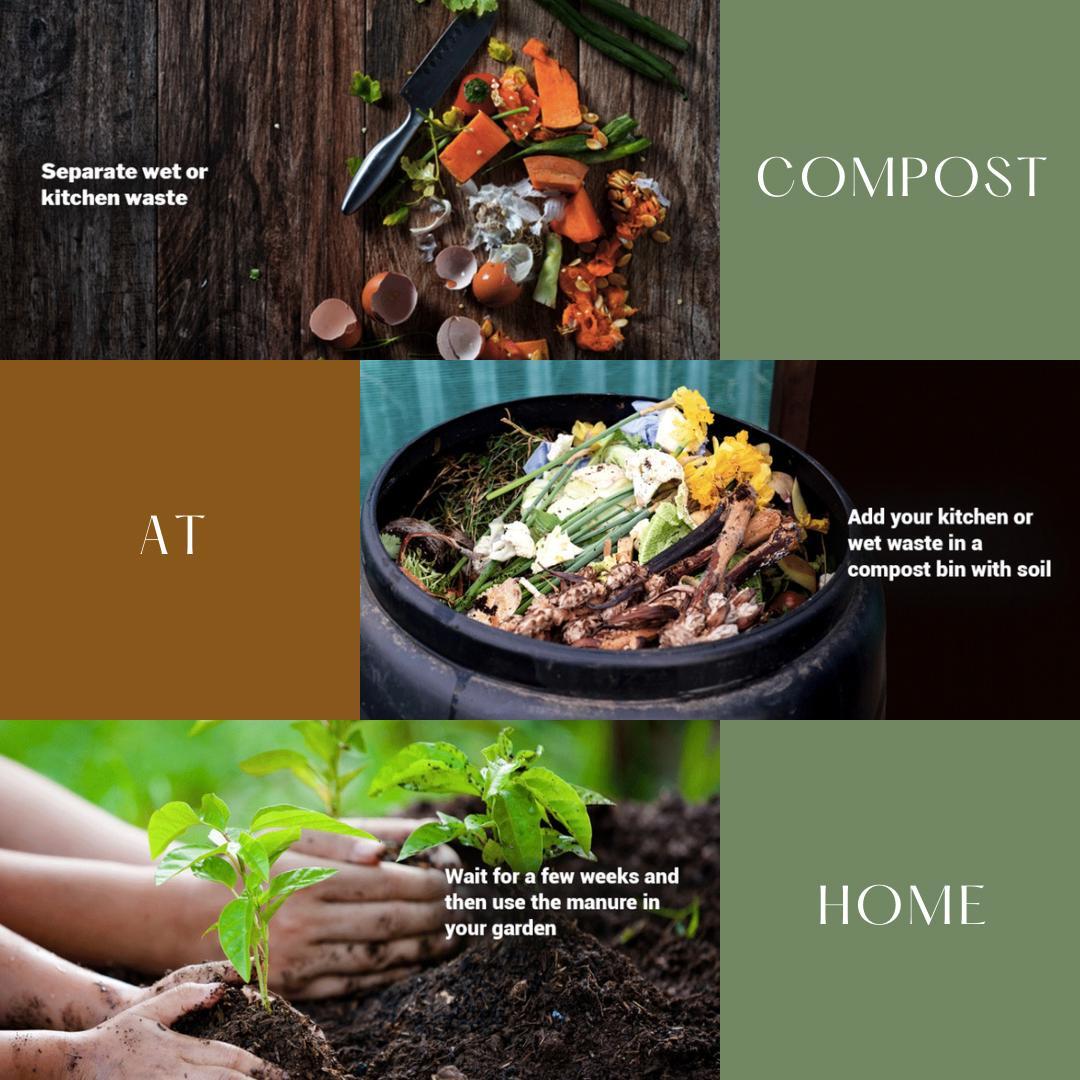
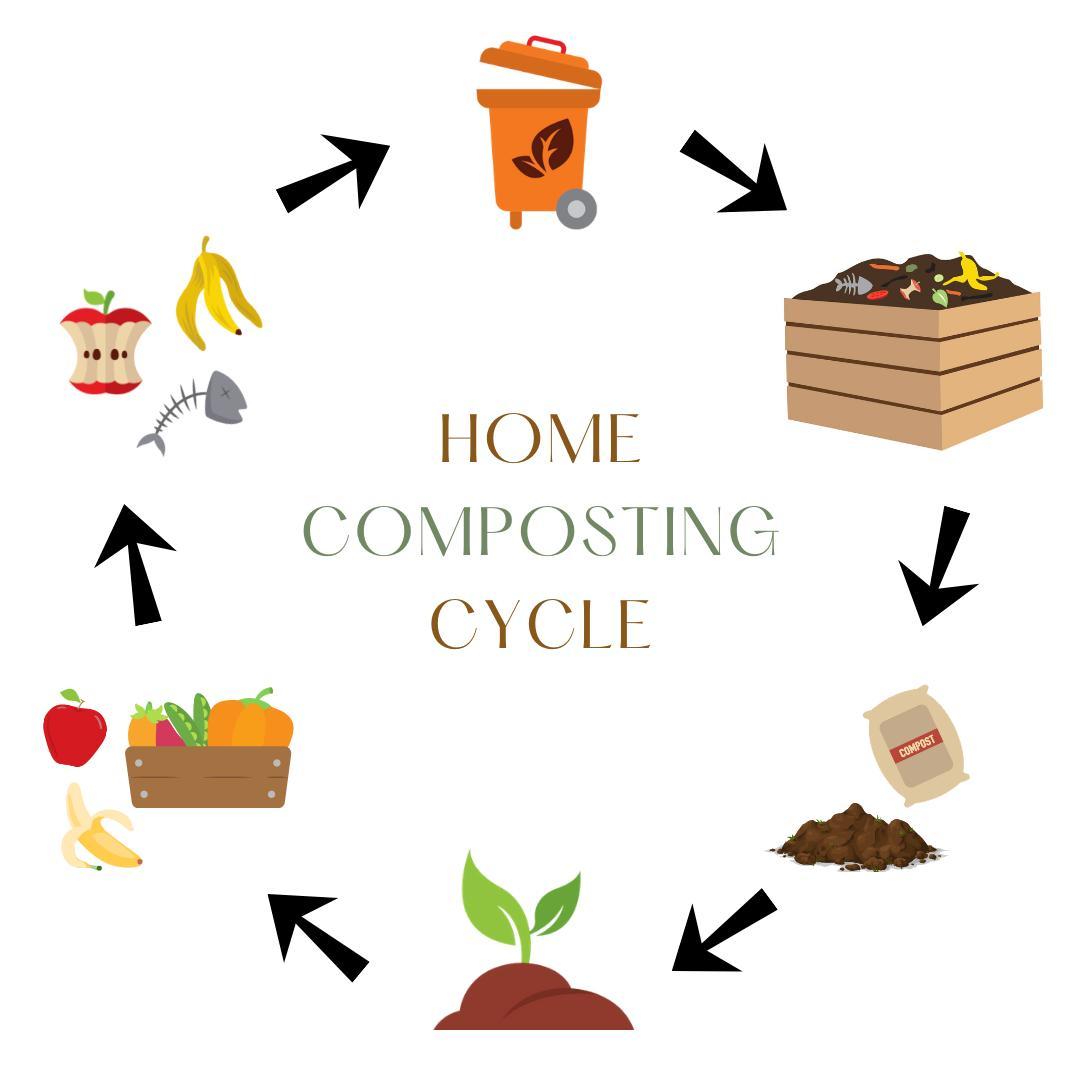
How to compost? – Get a small home composting kit – a bin, a compost starter culture and you are set. Add a healthy mix of your kitchen uncooked waste, dried leaves, hair, eggshells, paper etc. Layer your waste and compost starter culture one above the other. Ensure the pile gets airflow and voila you have started on your composting journey!

This seemingly inane product has multifold benefits:

  1. Reducing Greenhouse Gas emissions

Making compost keeps these materials out of landfills where they take up space and release methane, a potent greenhouse gas.

  1. Upgrading common household waste

In addition to reducing land, water and air pollution, reducing methane emissions from landfills and lowering your carbon footprint, composting has the benefit of making manure from kitchen and yard waste. Composting makes literally common household waste into an incredibly valuable resource, one that will generate more food and revenue. By completing the food cycle, garbage becomes black gold. From Garbage to Garden!

  1. Soil Improvement and nourishment

Franklin D Roosevelt, 32nd President of the United States famously said “The nation that destroys its soil, destroys itself”. The soil literally feeds us. We need to look at composting as merely returning the favour and nourishing the soil! Compost is used to improve soil structure through the addition of carbon and provides plant nutrients. In addition to being a source of plant nutrients such as nitrogen (N), phosphorus (P) and potassium (K), it improves the Physico-chemical and biological properties of the soil. 

Compost acts as a food source, a probiotic, and a sponge for the soil underneath it. Adding compost enriches the soil, helping retain moisture and suppress plant diseases and pests. This in turn reduces the need for chemical fertilizers. Composting encourages the production of beneficial bacteria and fungi that break down organic matter to create humus, a rich nutrient-filled material.

  1. Reducing Soil Erosion and replenishing groundwater

Compost can hold up to 5-20 times its weight of water. This means compost enables increased penetration of water into the soil. In addition to replenishing the water table, this property of compost can also help reduce soil erosion. By acting like a sponge and allowing more water to seep into the soil, compost actually helps retain topsoil and reduce soil erosion.

  1. Reducing waste disposal costs

From INR 15,287 billion a year in 2010 to a projected INR 27,964 billion by 2025, global costs of waste disposal are increasing. Backyard composting is the simplest way to decrease landfill costs as well as waste storage and transportation costs. 

  1. Lowering food production costs

Using compost reduces the need for chemical fertilizers which means a dramatic decrease in production costs. Also, some studies indicate usage of compost increases yields which translates to increased revenues for the farmer

  1. Building a Circular Economy

Reduce, Reuse and Recycle – Composting checks every one of these boxes. Composting is part of a whole circular economy that changes how we interact with our world and the environment. Nothing is wasted in nature—everything returns back into the soil to nurture new life.

Composting is in reality a very simple and manageable process that can have a huge environmental, economic and social impact. Most home composting systems do not need more than 2-3 minutes of your time daily. All you need is a composting bin, greens and browns and a heart to save the planet!

Sujatha Krishnamurthy, Co-Founder, Ekobarn

May 1, 2021 0 comment
0 FacebookTwitterPinterestEmail
cow in vedas
Authored ArticlesExpert Corner

The cow is called Dhenu in Vedas, the bestower of all bounties

by Team Conscious Carma April 29, 2021
written by Team Conscious Carma

The wonder of Desi Cow

Ever observed a hump on the spine of a desi cow or bull? It is called the Suryaketu Nadi. When the rays of the sun (surya) fall on this nadi, then specific energy is channelized inside the cow/bull. When a cow and bull mate, this energy transfers to their calf and also to the milk that the cow gives. This milk is called A2. Today A2 milk is much in demand as it can be digested even by those who are lactose intolerant and it is known to cure various ailments. This is the wonder of the desi cow. Interestingly, the milk given by jerseys, which are not even cows, is called A1 and the milk from desi cow is called A2. This is the conspiracy of the West. We will start our discussion from here.

The cow conspiracy

When Britishers came to India, at that time, even the Mughals had imposed a ban on cow slaughter. Mughals came with the intention of settling here, the Britishers however were here to loot and plunder and go back to their own country. They wanted to make a colony out of India. Today we say with pride, ‘colonial’ furniture, ‘colonial’ architecture – these are in great demand. The joke is on us only. In 1760, Robert Clive set up the first slaughterhouse in Bengal. Within ten years, Bengal witnessed the worst famine of all times, where lakhs died. This was the conspiracy of Britishers, they knew cow is the backbone of our agricultural economy, if you remove the cow/bull, the economy will collapse. Clive who orchestrated this heinous crime, himself became an opium addict and killed himself using a knife…

The bestower of all bounties

All through the Vedas, the killing of cows has been banished and seva or service to the cow/bull has been emphasized. The cow is called dhenu in Vedas, the bestower of all bounties. To the countrymen who find sense in all things western, even the West acknowledges this. Today a therapy is in rage in the West, it is called cow-cuddling therapy – go to a gaushala and hug and pet a cow, and it will help rid you of your ailment. Follow them, if not the Vedas.

Nurse a cow and reap the benefits

Dhyan Foundation is running gaushalas all across the country to serve and nurture this wondrous animal. These gaushalas are home to thousands of stray, injured, sick or abandoned cows, bulls and calves including those rescued from the smugglers at the Indo Bangladesh border by the Border Security Forces. Volunteers and sadhaks devote their time, energy and resources to nurse these animals back to health, to reduce their pain and suffering. You too can join us and reap the benefits of serving this animal.

Click on the image to access our magazine to read the full article

–Yogi Ashwini, Dhyan Ashram

April 29, 2021 0 comment
0 FacebookTwitterPinterestEmail
Authored ArticlesExpert Corner

No Excuse To Avoid Sustainable Practices Anymore

by Team Conscious Carma April 28, 2021
written by Team Conscious Carma

Let’s talk about the economic viability of investing in nature.

The business world, by its very nature, is a world prone to undergoing major upheavals and changes on a rather regular and sustainable basis. Be it the introduction of robots in the manufacturing sector that speeded up the production process. Or others that reduced the costs or the implementation of newer, more efficient technologies in supply-chain and logistics that cut many insignificant expenses – the changes have been transformative. However, when looked at closely, all of these changes have one unifying factor at their core that makes them successful – profit.

Nature-positive business models cannot come at the cost of a company’s profit.

As a professional who’s been active in the business world, and fortunate enough to work with businesses across their life cycles, I have come to realize the importance of adopting practices that lead to a nature-positive economy, ie businesses that add value to nature. And how the effort from the entire business ecosystem is needed to bring about a sustainable change.

A New Era of a Carbon-Conscious Community

The business world is once again at the cusp of a massive transformation, perhaps its most significant one yet, whose consequences would be felt for a long time.

For decades, the business world brushed aside the ideas and suggestions to implement sustainable measures or invest in green development, not because it didn’t recognize its importance but simply because the move wasn’t economically viable. The lack of preference for eco-friendly products and services in the customers merely reinforced this status quo.

Today, there is a general awareness among people to adopt products and services which impact positively towards nature.

The falling costs of renewable energy sources, coupled with the increasing preference for eco-friendly products in the consumers and the rising demands for companies to reduce their carbon footprint, have all come together and created a unique opportunity for businesses to reduce their carbon footprint, a move that would not only provide significant environmental benefits but also tangible economic benefits.

In a report published by the World Economic Forum, experts predict that if the destruction of nature continues, as usual, it would have a huge impact on the economy and society at large. Globally, $44 trillion in GDP is potentially threatened by nature loss. The climate crisis is currently responsible for about 11 per cent and 16 per cent of biodiversity loss.

The potential for being environmentally conscious is enormous and has a measurable impact. The WEF report highlights opportunities towards a people and nature-positive development worth $10 trillion that could in turn create 395 million jobs by 2030.

The realization of the enormous financial advantages has spurred many companies to recalibrate their growth strategies and future development plans by putting green development at its centre. Many large corporates have broadly realized that transitioning to a nature-positive business model is in their interest. Leading manufacturer of packaging and graphic boards in South Asia, ITC has announced sustainable packaging solutions with the development of innovative B2B value-added paperboards. It covers environmentally sustainable, recyclable, and compostable materials.

P&G has also taken a step in its design to reduce its carbon footprint. The company announced a host of innovative products that can help save energy, water, and natural resources. Measures like optimization of detergent formulas for high efficiency at low temperature, cascade, and Fairy Automatic Dishwashing Tablets allow consumers to skip pre-wash and save water and the energy needed to heat the water. Such small steps will have a lasting impact.

Let’s Amplify These Voices

These are monumental changes made by huge corporations and must not go unnoticed. Their actions deserve to be amplified. It should inspire medium and small-sized organizations to follow suit. Concurrently, policy-makers must spur into action and incentivize the adoption of sustainable solutions at the grassroots. We cannot operate in silos. We have to join hands to make change happen for future generations.

With time, sustainable solutions will become the norm and help us to move towards a nature-positive economy. In September 2020, top automobile manufacturers faced a roadblock due to the Covid-19 induced lockdown. But Indian Railways provided them with an opportunity to ferry their commodities across the country in passenger train services. The industry has gradually utilized the vast network of Indian Railways to transport its vehicles.

This shift leaves a huge impact on the environment as transporting freight by train generates up to 80 per cent less CO2 and consumes 75-90 per cent less energy than road transport. The roads are also less clogged.

Change Can Be As Simple and Complex As We Make It To Be

It’s time for us to come together and think about the axis of the relationship between businesses and the economy. If we are to move towards sustainability, everyone has to come together. It cannot be one or two or even ten organizations. The exchange of knowledge among industry leaders – small and big – is crucial. Imagine the trickle-down effect of such a movement!

The onus is on the entire ecosystem. It’s on all of us.

Mr. Amit Banka, Founder, WeNaturalists

While working with Swades Foundation on holistic living projects in rural India, Amit Banka realized the need for mankind to coexist with nature, and more importantly, mankind’s dependence on it. The learnings from these interventions reinforced his belief that human interaction with nature needs to evolve to create a larger impact. This tremendously influenced his outlook towards creating WeNaturalists, an ecosystem of people from around the world, connected by their love for nature and enable them to explore new opportunities, collaborate on work and research, contribute to environmental causes, participate in global events, share knowledge, and learn new skills – all in one place.

April 28, 2021 0 comment
0 FacebookTwitterPinterestEmail
Authored ArticlesExpert Corner

Benefits of Sustainable and Clean Beauty & the Importance of Switching to Sustainability

by Team Conscious Carma April 26, 2021
written by Team Conscious Carma

Walking down the aisles of fancy products with minimalistic lettering, these products yell age-defying, skin brightening to pore-minimizing benefits with their “suspicious-six’’ ingredient list strategically mentioned on their luxurious packaging. 

Have you ever thought of cross-checking or even getting into a detailed understanding of the ingredients? If you haven’t, it’s time you must delve into the formulation list of each product before you make a purchase because there’s an ugly truth associated with the glorious beauty industry: animal testing and toxins. Luckily, there’s a clean way to be more conscious of your health and environment by choosing clean over chemicals. Clean beauty is the dawn of a new evolution in the beauty arena with an alternate range of natural, organic, toxin-free, cruelty-free beauty products. It’s no secret that clean beauty is widely celebrated for its sustainability and miraculous skincare benefits in the most eco-friendly manner.

Have you ever thought that your daily beauty regime has an impact on the environment? Did you know that we dump around 2.12 billion tons of waste every year, out of which 75 per cent of waste is from the beauty industry? Unfortunately, our environment is paying the price of our overwhelming consumption of plastic and toxic ingredients that are not eco-friendly. It’s high time that we all should make a switch to eco-conscious alternatives not only for the benefit of our health but for the whole planet. Choosing clean, non-toxic, cruelty-free beauty products with sustainable packaging will be a baby step towards bringing in a huge change in the beautiful panorama. From packaging to ingredient sourcing, the beauty industry is evolving to be more conscious and sustainable for you, the future, and our planet. Let’s find sense in sustainability to do our bit for Mother Nature. Here are a few reasons why sustainability is the need of the hour.

Recycling Product Empties

Clean beauty brands stand strong and strike off the most egregious beauty sin: not recycling the empties. This initiative has definitely brought a change in the beautiful landscape and stops your product from going into landfills. A small effort that has a big impact on our landmines and oceans, all you have to do is send back the product empties that you have purchased from them and let the planet be grateful to you for your deed.

Reducing The Carbon Footprint

Sustainable brands promise to serve nature and the environment with the most transparent and conscious practices. Using clean products free from nasties such as silicones ensures that the product has less of an impact on the planet with carbon emissions. And, this is an important concern to address as it is causing global warming. Our carbon footprint is responsible for causing carbon oxide and other greenhouse gases that eventually trap that sun radiation causing the earth to heat up.

You Can Use Refills

It is great for both the environment and your budget. Most of the clean brands have started refill programs, so you don’t have to keep stocking up on empties and discard outer packaging each time you finish your product. You can get your hands on the refill, which is just perfect for the environment and your pocket.

It’s Simple 

In the era of minimalism, simple formulations are not only good for the skin but proven to be eco-friendly too. We all should pick a product that is twice as nice and do the right job for you. Picking up multi-purpose, simple clean beauty products like lip and cheek stains can be the best way to keep two extra products from ending up in the landfills. 

You know what you are using

Clean beauty is all about transparency and formulated using ethically sourced, natural, and organic ingredients without any toxins and cruelty. An environmentally woke brand with plant-powered constituents is sure to keep your skin and planet happier and healthier. 

It’s never too late to start a non-toxic journey and be sustainable with your choices. A small step towards greener choices in favour of our planet will definitely make a difference. This time your actions will be louder than words, read the label before you purchase any brand. Always opt for a brand that resonates with your values and thought process and know that the power is in your hands to make the change and be the change. 

Consider all the factors: what is in it? Is it recyclable? How was it made? And you’ll know it. 

Naina Ruhail Co- Founder Vanity Wagon

DISCLAIMER: The views expressed are solely of the author and CONSCIOUS CARMA does not necessarily subscribe to it. CONSCIOUS CARMA will not be responsible for any damage caused to any person or organisation directly or indirectly.

April 26, 2021 0 comment
0 FacebookTwitterPinterestEmail
Authored ArticlesExpert Corner

Switch to conscious lifestyle products to restore Mother Earth

by Team Conscious Carma April 25, 2021
written by Team Conscious Carma

The ‘Pale Blue Dot’ is an iconic photograph of the Earth taken by a Voyager 1 in 1990, from about 6 billion kilometres away. When released, it instilled a deep sense of wonder and inspired an entire generation – to think about the vastness of the universe and the vulnerability of our existence. 

This realization may come to us in simpler ways too, just from daily observation. And it need not always be based on fear and alarm. Yes, a lot is wrong with the world today – our waste is growing, forests are shrinking, and the ocean is dying. At the same time, externalizing our motivation may sometimes lead to it being short-lived – the equivalent of a snow-blizzard making people think the planet is not warming up. 

Human presence on earth is but a blink in the planet’s history, but we have evolved to alter our world in ways no other species ever has. As such, when we think about sustainability, it is a helpful reminder that an individual lifespan is fleeting at best. Our love and admiration should be for something bigger – for the wonders of this planet, the amazing laws that govern it, and how we interact with them. If we base our motivation on this beauty, we may be able to take a longer view that outlives us – that we want to preserve this place – not for ourselves, but because it is worth preserving. 

Making conscious lifestyle choices is a small but powerful expression of this love. Of course, we need basics for sustenance, but being conscious about ‘how much we need is an extremely valuable step we can all take. 

In the globalized, industrialized world, supply chains are complex. An ingredient for a small, obscure product may be getting shipped from halfway across the world, maybe diverting resources critical to that local population, and if nothing else, will generate some form of waste. The key question to be asked is – ‘do I absolutely need this?’. After all, our demand fuels the production. 

The world today supports ~7.8 billion people, with resource demand out-pacing nature’s ability to replenish. However, much of this accelerated consumption is driven by recent trends and throwaway systems. India has been home to many traditional methods that are now emerging as ‘sustainable’ ideas; making cleaning clothes out of old shirts, sharing clothes and books, shopping locally and un-packed groceries, to name a few. Simple steps like these tremendously bring down consumption and wastage; that much lesser land must be cleared out for agriculture and waste landfills, those many fewer animals die, that much fuel is saved on production – it is extremely intuitive if we think about it!

So, if you are someone seeking a conscious lifestyle, begin with reducing. Shopping locally from eco-conscious brands is a great step, but the most sustainable product is the one we did not buy. It also helps to be mindful of the end-of-life of the product and its packaging; will it drain harsh chemicals into our soil and water? Can I re-use that plastic bottle as much as possible? Should I refuse to buy something with excessive wrapping? What will happen to this take-out container? 

As mentioned before, one cannot disregard that many of our ecosystems are at the brink of collapse. This realization can be overwhelming, sometimes all-consuming. But there is an inspiration to be drawn from large, collective action being taken across the world to slowly restore Mother Earth. And we can all contribute by making conscious choices, starting today. 

For this amazing blue dot. Home to all of us.

Gauri Gupta, Founder, Arani Ecosteps

April 25, 2021 0 comment
0 FacebookTwitterPinterestEmail
Newer Posts
Older Posts

Recent Posts

  • India–UK Free Trade Agreement Opens Global Growth Opportunities for 3R ZeroWaste’s Circular Economy Solutions
  • Plastic Free July: Why True Sustainability Goes Beyond Swapping Plastic
  • From the Editor’s Desk: When Greed Takes Over Conscience
  • Beyond the Pose: Why Your Yoga Mat Needs a Sustainable Upgrade
  • Best Sustainable Father’s Day Gifts: Conscious Carma’s Exclusive Picks

Recent Comments

  • Team Conscious Carma on Label Shivika Agarwal – where craft meets sustainability
  • Cocomeister.jp on Label Shivika Agarwal – where craft meets sustainability
  • Team Conscious Carma on Equitable City Designs To Fight Climate Change
  • UN report calls for repurposing of USD 470 billion of agricultural support that distorts prices and steer us away from environment and social goals | Consciouscarma on UNEP & ICMR collaborate to boost understanding of environmental dimensions of antimicrobial resistance in India
  • Wild Earth : Natural body products | Consciouscarma on Sat.Suma : the true essence of flowers in your everyday skincare needs

Keep in touch

Facebook Twitter Instagram Youtube

Recent Posts

  • India–UK Free Trade Agreement Opens Global Growth Opportunities for 3R ZeroWaste’s Circular Economy Solutions

  • Plastic Free July: Why True Sustainability Goes Beyond Swapping Plastic

  • From the Editor’s Desk: When Greed Takes Over Conscience

  • Beyond the Pose: Why Your Yoga Mat Needs a Sustainable Upgrade

  • Best Sustainable Father’s Day Gifts: Conscious Carma’s Exclusive Picks

  • How Sacred Sound is Reshaping the Future of Holistic Health?

Categories

  • Community (38)
    • Campaigns (3)
  • CSR (4)
  • Economy (82)
    • Global (24)
    • Industry (42)
    • Innovations (4)
    • National (2)
  • Environment (48)
  • Expert Corner (48)
    • Authored Articles (47)
  • Featured (5)
    • Partners (1)
  • Global News (2)
  • Initiatives (31)
    • CSR (3)
    • Events (6)
  • Inspiration (22)
  • Lifestyle (9)
  • Media Coverage (6)
  • Press Releases (4,358)
  • Products (126)
    • Accessories (27)
    • Apparel (32)
    • Beauty (26)
    • Food (4)
    • Gifting (3)
    • Home Décor (15)
    • Skin-Care (14)
  • Reports (3)
  • Spirituality (10)
  • Sustainability (49)
  • Sustainable Startup Stories (28)
  • Travel (19)
  • Uncategorized (2)
  • Wellness (33)
    • Home Cleaners (3)

Archives

  • August 2026 (1)
  • July 2026 (1)
  • June 2026 (6)
  • October 2024 (1)
  • September 2024 (1)
  • July 2024 (2)
  • June 2024 (2)
  • May 2024 (1)
  • November 2023 (330)
  • October 2023 (554)
  • September 2023 (631)
  • August 2023 (718)
  • July 2023 (723)
  • June 2023 (710)
  • May 2023 (608)
  • April 2023 (114)
  • March 2023 (7)
  • February 2023 (3)
  • January 2023 (11)
  • December 2022 (18)
  • November 2022 (1)
  • August 2022 (6)
  • July 2022 (8)
  • June 2022 (24)
  • May 2022 (11)
  • April 2022 (19)
  • March 2022 (11)
  • February 2022 (11)
  • January 2022 (14)
  • December 2021 (10)
  • November 2021 (4)
  • October 2021 (14)
  • September 2021 (22)
  • August 2021 (12)
  • July 2021 (17)
  • June 2021 (17)
  • May 2021 (16)
  • April 2021 (22)
  • March 2021 (33)
  • February 2021 (16)
  • January 2021 (22)
  • December 2020 (10)
  • Facebook
  • Twitter
  • Instagram
  • Pinterest
  • Linkedin
  • Youtube

@2020 - All Right Reserved. Designed and Developed by Bizopser Technologies

Consciouscarma
  • Home
  • About Us
  • Products
  • Community
    • Campaigns
    • Inspiration
    • Initiatives
    • CSR
  • Features
    • Sustainable Startup Stories
    • Travel
    • Lifestyle
    • Partners
  • Economy
    • Industry
    • Innovations
    • National
    • Global
  • Environment
  • Expert Corner
    • Authored Articles
    • Reports
  • Magazine
  • Contact