Consciouscarma
  • Home
  • About Us
  • Products
  • Community
    • Campaigns
    • Inspiration
    • Initiatives
    • CSR
  • Features
    • Sustainable Startup Stories
    • Travel
    • Lifestyle
    • Partners
  • Economy
    • Industry
    • Innovations
    • National
    • Global
  • Environment
  • Expert Corner
    • Authored Articles
    • Reports
  • Magazine
  • Contact
Category:

Authored Articles

Authored ArticlesHome Décor

Sustainability in the Interior Design Industry Opportunities and Challenges

by Team Conscious Carma June 29, 2022
written by Team Conscious Carma

By Deepika Jindal, Creative Head, JSL Lifestyle Ltd – In order to produce long-lasting, high-quality designs with minimal environmental effect, waste, and pollution – sustainable interior design must be consciously incorporated. Innovation is critical when it comes to creating these spaces. From planning to design, construction, operation, maintenance, restoration, and demolition, one must rely on ecologically responsible and resource-efficient techniques at every step to create a sustainable ecosystem.

Ranging from resource depletion and biodiversity loss to health impacts and trash generation, materials contribute majorly to the way spaces work. It is crucial to comprehend the journey these resources take, and also if their transformation into goods is sustainable. For instance, are the materials obtained responsibly and ethically? Are employees paid a liveable wage? Is their workplace safe and sanitary? Are the materials treated with harmful substances? Do the building’s materials contribute to its efficiency? If they are renewable, are they responsibly renewed?

From thermal performance to general durability, determining an interior’s environmental impact is imperative. However, the process of vetting sustainable materials is still a weak link. There is a lack of consistency and reliability that can authenticate the virtues of sustainable materials among designers. Despite these obstacles, few businesses and organisations continue to provide transparent and diligent materials with standardised information to promote environmental objectives. Designers can embrace this as an opportunity to independently reduce, reuse, and recycle resources by employing alternative materials and monitoring waste generation.

Technological advances in material science have resulted in the development of substitutes, such as stainless steel, that seek to meet all modern requirements while having the least environmental impact. Using stainless steel in interior design opens up a world of possibilities, such as the ability to customize and combine components, as well as resistance to delicate design elements. Given the environmental consequences of most materials, stainless steel is a significant calling.

Blended in style, luxurious craftsmanship, and environmental empathy, the AID community can pick on the stainless steel culture and turn it into a must have. After all, even legendary car maker Ferrari chose to embellish its historic property in Maranello, Italy, with this haute-couture overlay on the 7,000 square metres of the building exterior. For the uninitiated, the iconic Ferrari factory’s present facade is covered in sheets of reflective red steel. Interestingly, glass and stainless steel with a mirror finish are two of the most common materials utilised for modern buildings’ exteriors. The reflective glass used in the glass modules is meant to mimic the appearance of reflected steel while also limiting solar heat gain

Stainless steel has been employed in interior design for decades because of its effective functionality. As pioneers in reimagining stainless steel into artful tableware and décor pieces, we have closely observed the evolution of this material into collectible masterpieces. Firstly, its capacity to be coloured in over 220+ hues makes it an attractive material for design.  Secondly, stainless steel is durable, 100% fire resistant, moldable and rust resistant. Furthermore, it can be applied to create wall speartes, planters, cladding, wardrobes, vanity, chandeliers, lamps, mirrors, and several other products.

Having led a group of creative designers at Arttd’inox, I have witnessed how a culture of creative collaboration is redefining the ways stainless steel can be interpreted, highlighting the material’s genuine chic potential in everyday life. Designers can appreciate its aesthetic qualities and futuristic appearance by incorporating it into contemporary decor.

Did you know? All stainless steel kitchens are termite free, hygienic, durable, and environmentally friendly. In fact, the most recent innovation in this area is an ‘all stainless steel kitchen’ concept with over multiple colour options and top-notch German finishes. These kitchens combine innovative contemporary design with great utility

To top it all off, stainless steel light reflections are nothing short of magnificent. It can be used repeatedly to polish surfaces, resulting in a glossy sheen. The polished mirror finish produces an excellent lustre, and its reflection displays a gentle contrast, adding to the beauty of any product. Moreover, the silvery appearance complements virtually all aesthetics and offers daring combinations with rich woods, leather, lacquer, and other matte materials. Additionally, the fact that it is available in 220+ colours makes it an ideal choice for interior design.

Combining innovative design with environmental and social considerations displays a purposeful and authentic design philosophy. From harsh weather to melting ice sheets and rising sea levels, there is no denying that sustainable solutions are the need of the hour. Therefore, it is time to reinvent the components and objects of daily existence as graceful designs and unique avatars that not only indulge the eyes and please the soul, but also improves the environmental condition of our planet.

Ecologically friendly interior design is an interconnected system. There is a ripple effect that begins with you (and your loved ones) in your own home, linking to the earth and reverberating outwards to your neighbours, the people who created your home goods

(and to our communities at large). Finally, our world’s economics and cultures form the outer ring of this ecosystem. This holistic approach encourages us to look more broadly about what we bring into our house and gives us more options for styling our interiors for both beauty and effect.

June 29, 2022 0 comment
0 FacebookTwitterPinterestEmail
Authored ArticlesIndustryInnovations

EV Battery Recycling

by Team Conscious Carma June 28, 2022
written by Team Conscious Carma

Sushobhan Mahanty – For the past century, civilization has heavily relied upon fossil fuels to literally power their lives. The urgent need to cut carbon emissions is prompting a rapid move toward electrified mobility and expanded deployment of solar and wind on the electrical grid.

With the complete world shifting its focus towards electric vehicles and other Li-ion battery products, the production size of those batteries is anticipated to be very high. The increasing volume of Li-ion batteries would successively cause a growing capacity of ‘spent’ batteries within the ecosystem.

Like many other batteries, the Li-ion cells that power most EVs rely on raw materials, like cobalt (Co), Li, and rare earth elements, that have been linked to grave environmental and human rights concerns. Extracting the metals from their ores is an “emission rich” process… emits SOx, CO2, etc. A study conducted by the IVL Swedish Environmental Research Institute states that manufacturing an electric car battery requires around 350 to 650 MJ of energy per kWh and a regular battery pack of an EV can generate 80g to 90g of CO2. In Chile’s Salar de Atacama, a significant center of Li production, 65% of the region’s water is consumed by mining activities. This affects farmers within the region who must then import water from other regions.
So, here we are able to understand the importance of recycling batteries. The limited lifetime of these batteries would eventually produce dead batteries which might require a good process to recycle them.

EV batteries aren’t yet recycled at scale. The market continues to be in its infancy. To bring down the imports and make battery manufacturing sustainable it’s necessary to speculate early in large-scale recycling infrastructure. Further, the changing international and political relations with countries owning natural reserves of those key metals and staples and fluctuating prices of raw materials in global markets could also impact the battery prices. A rise in the price of batteries could increase the cost of EVs and be a hindrance to the sale of EVs. Many companies in India have already started viewing this chance and have either already established or announced plans to line up recycling operations.

While recycling, the goal is to recover the utmost number of reusable resources while consuming the minimum amount of energy. The recycling of an EV’s battery faces a double challenge: reduce the number of waste generated by an electric battery at the tip of its life and encourage the reuse of as many components and resources involved in its manufacture as possible.

Recycling EV batteries at end-of-life are essential as it may prove to be a valuable secondary resource for critical materials. Careful management of the resources consumed by EV battery manufacturing, and recycling, surely holds the key to the sustainability of the future automotive industry.

About the author: Sushobhan Mahanty, pursuing electrical engineering, is a contributor at Conscious Carma. Having a keen interest in sustainability, he is currently exploring various sustainable fields like renewables and electric vehickes, etc and is running a newsletter on LInkedin, “Sustainability Vibes”.

June 28, 2022 0 comment
0 FacebookTwitterPinterestEmail
Authored ArticlesEnvironment

Environment Performance Index: India fails green test, finishes at bottom

by Team Conscious Carma June 10, 2022
written by Team Conscious Carma

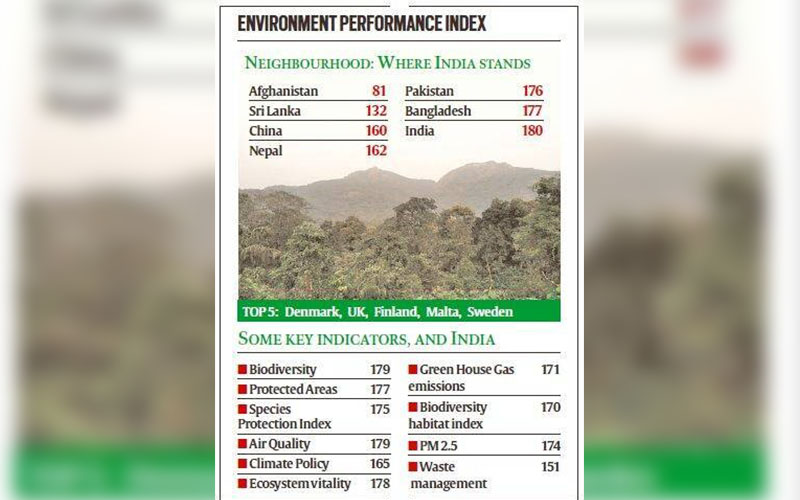
The recently released Environment Performance Index-2022, an international ranking system that measures environmental health and sustainability of countries, has ranked India last among 180 countries that have been ranked.

With a paltry score of 18.9, India’s 180th ranking comes after Pakistan, Bangladesh, Vietnam and Myanmar — the bottom five together make up the poorest performing countries for environmental health.

India has also scored low on rule of law, control of corruption and government effectiveness, according to EPI.

The EPI, a biennial index, was started in 2002 as Environmental Sustainability Index by the World Economic Forum in collaboration with the Yale Center for Environmental Law and Policy and the Columbia University Center for International Earth Science Information Network.

“Using 40 performance indicators across 11 issue categories, EPI ranks 180 countries on climate change performance, environmental health, and ecosystem vitality. These indicators provide a gauge at a national scale of how close countries are to established environmental policy targets,’’says the EPI report.

Overall EPI rankings indicate which countries are best addressing environmental challenges , it states.
The report has found that “good policy results are associated with wealth (GDP per capita)’’, meaning economic prosperity makes it possible for nations to invest in policies and programmes that lead to desirable outcomes. “This trend is especially true for issue categories under the umbrella of environmental health, as building the necessary infrastructure to provide clean drinking water and sanitation, reduce ambient air pollution, control hazardous waste, and respond to public health crises yields large returns for human well-being,’’ the report states.

India was ranked 168th in EPI-2020, with a score of 27.6 In EPI-2020, Denmark has been ranked first in environmental health and sustainability. (Image: Pixabay)

The pursuit of economic prosperity — manifested in industrialisation and urbanisation — often means more pollution and other strains on ecosystem vitality, especially in the developing world, where air and water emissions remain significant, it says. The report says that top-performing countries have paid attention to all areas of sustainability, while their lagging peers tend to have uneven performance.

“In general, high scorers exhibit long-standing policies and programs to protect public health, preserve natural resources, and decrease greenhouse gas emissions. The data further suggest that countries making concerted efforts to decarbonize their electricity sectors have made the greatest gains in combating climate change, with associated benefits for ecosystems and human health,’’ says the report.

The report states: “A number of important countries in the Global South, including India and Nigeria, come out near the bottom of the rankings. Their low EPI scores indicate the need for greater attention to the spectrum of sustainability requirements, with a high-priority focus on critical issues such as air and water quality, biodiversity, and climate change. Some of the other laggards, including Nepal and Afghanistan, face broader challenges such as civil unrest, and their low scores can almost all be attributed to weak governance.”

June 10, 2022 0 comment
0 FacebookTwitterPinterestEmail
Authored ArticlesEconomy

Record US$14.5 billion investment in Indian renewable energy sector in last financial year

by Team Conscious Carma June 10, 2022
written by Team Conscious Carma

Investment in renewable energy in India reached a record US$14.5 billion in the last financial year (FY2021-22), an increase of 125% compared to FY2020-21 and 72% over pre-pandemic FY2019-20, finds a new report by the Institute for Energy Economics and Financial Analysis (IEEFA).

“The surge in renewables investment comes on the back of the revival of electricity demand from the COVID-19 lull and commitments by corporations and financial institutions to net-zero emissions and to exit fossil fuels,” says the report’s author Vibhuti Garg, Energy Economist and Lead India, IEEFA.

“After falling by 24% from US$8.4 billion in FY2019-20 to US$6.4 billion in FY2020-21 when the pandemic curbed electricity demand, investment in renewable energy has made a strong comeback.”

The report highlights the key investment deals made during FY2021-22. It finds the majority of the money flowed through acquisitions, which accounted for 42% of the total investment in FY2021-22. Most of the other big deals were packaged as bonds, debt equity investment and mezzanine funding.

The largest deal was SB Energy’s exit from the Indian renewables sector with a sale of assets worth $3.5 billion to Adani Green Energy Limited (AGEL). Other key deals included Reliance New Energy Solar’s acquisition of REC Solar holding assets and a host of companies like Vector Green, AGEL, ReNew Power, Indian Railway Finance Corporation and Azure Power raising money in the bonds market.

India added 15.5 gigawatts (GW) of renewable energy capacity in FY2021-22, which brings the total installed renewable capacity (excluding large hydro) to 110GW as of March 2022 – a long way off the target of 175GW of renewable energy capacity by the end of this year.

Even with the surge in investment, renewable capacity will have to expand at a much faster rate to reach the target of 450GW by 2030, says Garg.

“The Indian renewable energy sector needs about US$30-US$40 billion annually to meet the 450GW target,” she says. “This would require a more than doubling of the current level of investment.”

Rapid growth in renewable energy capacity will be needed to meet India’s increasing electricity demand. To move to a sustainable pathway and reduce reliance on expensive fossil fuel imports, Garg says the government needs to act as an enabler by rolling out ‘big bang’ policies and reforms to accelerate the deployment of renewable energy.

“This means not only increasing investment in wind and solar power capacity, but also in creating an entire ecosystem around renewable energy,” she says.

“Investment is needed in flexible generation sources such as battery storage and pumped hydro; expansion of transmission and distribution networks; modernisation and digitalisation of the grid; domestic manufacturing of modules, cells, wafers and electrolysers; promoting electric vehicles; and promoting more decentralised renewable energy such as rooftop solar.”

June 10, 2022 0 comment
0 FacebookTwitterPinterestEmail
Authored Articles

Everything in creation is either going up or it is going down, nothing is stationary

by Team Conscious Carma May 27, 2022
written by Team Conscious Carma

By Yogi Ashwini, Dhyan Ashram, Presently we are living on earth, but if anyone thinks that he/she will continue to be here birth after birth, it is a mistaken notion. Like everything in Creation, a being too, moves up or down. Earth is only one level of existence, there are dimensions beyond and below.

The dimension of earth or Bhu loka, is special in that, from here one can reach any dimension based on his/her desire and backed by requisite karmas. Bhuva is the loka higher than earth, reaching here is possible only through complete detachment. Next comes Swarga loka which can be accessed through recommendation from gods and goddesses. There are specific mantras to please the divine to access Swarga loka.

The loka above Swarga is called the Maha loka, it is the dimension of those beings who are entitled for Swarga, but have no desire to enjoy its pleasures. Beyond this is the Jana loka. Here the beings responsible for creating the ‘software’ that runs the entire creation, reside. Tapa is the next loka and it is for beings who desire to do tapasya. The heat generated by their tapasya gives energy to the sun, powered by which the entire creation runs.

The final dimension is the Satya lok where Brahma, Vishnu and Mahesh reside. Only souls which have an unshakable desire to merge with these energies are able to reach here. At the gate of Shiv Dham there are ganas in the form of bhooth, pret and pishach that try and dissuade a sadhak from entering. Nandi is one of the favorite ganas of Lord Shiv who fulfills all physical and material desires to keep the sadhak immersed in them so that he/she does not move to the Shiv Dham.


Even though light is the fastest thing on earth, it cannot traverse through these dimensions in an entire lifetime. Only thoughts can take us to these dimensions.

The dimensions below earth are- Atala, Vitala, Sutala, Talatal, Mahatala, Rasatala, Paatala, which we should just read and forget. These are for those beings who live a life devoid of service and charity, full of selfishness- in other words, a life of darkness. This includes beings who harm others or even after being in a position of preventing pain of others, look the other way. These souls are sent to these lower lokas to go through the processes of cleansing through pain, fear, claustrophobia and stickiness with slime. The lower worlds are dark as the occupants of these lokas desire only darkness. The forms taken by the souls in these dimensions are gross, slimy, painful and full of pure fear all the time.

In order to become eligible to go to any other loka- higher or lower, one has to come to Bhu loka. In  all the other lokas, the time for being is fixed, after the expiry of which one returns to Bhu loka. Even Lord Vishnu, who resides in Vaikunth, which is a subtler part of Satya loka, has to descend to Bhuloka to discharge his duties towards creation. So find a guru, and make the most of time you have, while you are in this dimension. Yoga under a guru is a journey with real experiences, not a day dreamers world where kathas and stories are told to you of others experiences, or where you sing, dance, listen to stories and come back poorer in your pocket. Its a journey into realty and its your individual journey.  

May 27, 2022 0 comment
0 FacebookTwitterPinterestEmail
Authored ArticlesEnvironment

Basanti Devi, environmentalist who saved Kosi River

by Team Conscious Carma May 23, 2022
written by Team Conscious Carma

Conferred with the Padma Shri Award this year for her contribution to the ‘Save Kosi Movement’ and environmental protection, Devi is also looked upon as a champion of women empowerment.

Indian environmentalist Basanti Devi was born in Pithoragarh (Uttarakhand) in 1958. She got married at a young age of 12 years while she was in class 5 and was widowed at 14. 

A chance visit to Kausani Ashram inspired her to take up social work and she decided to stay there and dedicate her life in serving humanity. At the ashram, she completed her studies as well as got involved with opening Bal Baris, recreational centres for children in remote villages, that also looked into their nutrition.

Thereafter, she was given the work to save water and the environment in Kosi river basin villages as level in water sources there was continuously depleting. The Kosi River  is an important resource in Uttarakhand. The river is responsible for major flooding in Bihar that can affect tens of thousands of hectares of land and a million people. Devi read an article that estimated that the river would cease to exist in a decade if the felling of trees continued at the current rate. She went to speak to local women explaining that this was their forest and their land and asking what they would do once the river had dried up. This began to convince people and both the villagers as well as timber companies agreed to cease to cut new wood. Villagers agreed that they would only burn old wood.

Devi then formed  Mahila Sangthans (women organisations) in almost 50 villages from Kausani to Katli village in Someswar which not only worked toward saving the environment of Kosi region but also empowered women by the way of their increased participation in social works.

For 20 years Devi used to travel in 50 villages of the Kosi region with the aim of saving trees, environment, empowering women and eradicating liquor consumption from the lives of villagers.

The effects have been slow to see but it is noted that springs that used to dry up in the summer now run all year. Moreover, the forest shows more diversity with more broad leafed trees and plants appearing.

“It started resulting in surplus water in once almost dry area of Kosi watershed region, now, after revival of some old springs, the villagers of Someswar area have started sowing to grow paddy crop”, says Devi.

She has also been honoured with Nari Shakti award 2016,  the highest award for women in India and DEVI award in 2016.

May 23, 2022 0 comment
0 FacebookTwitterPinterestEmail
Authored ArticlesWellness

Natural Ways to Keep a Check on Your Mental Health

by Team Conscious Carma April 12, 2022
written by Team Conscious Carma

It’s extremely imperative to take adequate care of yourself and get the most from life. Here are some practical ways I recommend to take respite from situations affecting your mental health. 

Talk about your feelings 

Talking about your feelings can help you stay in good mental health and deal with times when you feel troubled. It is in no way a sign of weakness.  Just being listened to can help you feel supported and less alone. And it works both ways. If you open up, it might encourage others to do the same.

Move More

Experts believe exercise releases chemicals in your brain that make you feel good. Regular exercise can boost your self-esteem and help you concentrate, sleep and feel better. Exercise also keeps the brain and your other vital organs healthy. Exercising doesn’t just mean doing sport or going to the gym. Walks in the park, gardening or housework can also keep you active. 

Simple tip: Walk 10K steps throughout the day. Start at 5K and build up. Every step you take counts, like going to the bathroom or walking in the aisle of your office. It all counts.

Eat Better
There are strong links between what we eat and how we feel, for example, caffeine and sugar can have an immediate effect. But food can also have a long-lasting effect on your mental health. Your brain needs a mix of nutrients to stay healthy and function well, just like the other organs in your body. 

SIMple tip: Eat at least 2 cups of vegetables and 2 seasonal fruits a day to get the best nutrition for yourself.

Stay Hydrated 
Water has been shown to have natural calming properties, likely as a result of addressing dehydration’s effects on the body and brain.  Drinking enough water is an important step in managing your anxiety. Even if you’re not experiencing anxiety, drinking sufficient water can create feelings of relaxation. We often drink alcohol to change our mood, but the effect is only temporary.  Drinking alcohol is not a good way to manage difficult feelings. So hydrate your body sensibly. 

SIMple tip: Drink 3 litres of water every day. This depends on a lot of aspects, check with you nutritionist for their recommendations too.

Keep in Touch 
Strong family ties and supportive friends can help you deal with the stresses of life. Friends and family can make you feel included and cared for.  There’s nothing better than catching up with someone face-to-face. But that’s not always possible. Give them a call, drop them a note or chat with them online instead. Talking about your feelings with someone will help calm you down too.

SIMple tip: Keep the lines of communication open. It’s good for you! Take the initiative to communicate if you wish to talk to someone.

Switch on Recovery Mode
A change of pace is good for your mental health. A few minutes can be enough to de-stress you. Take a deep breath… and relax. Try yoga or meditation, or just putting your feet up. Listen to your body. If you’re really tired, give yourself time to sleep. Without good sleep, our mental health suffers and our concentration goes downhill. Sometimes the world can wait. 

SIMple tip: Get at least 6-7 hours of sleep per night. This is very important for your health as a whole.

Indulge in Self Care 
When it comes to your mental health, self-care can help you manage stress, lower your risk of illness, and increase your energy. Even small acts of self-care in your daily life can have a big impact.

SIMple tip: Journal your gratitude and accomplishments. Write down 3 things you are grateful for each day, and 3 things you have accomplished. This can be as small as “added veggies to lunch”. Every small accomplishment matters. After doing this consistently, experience your life change for the better!

Spend Time with Yourself
Most people believe that because socializing helps relieve stress, it should be done from time to time. While there is no harm in that, it is also a good idea to know how to spend time with yourself and enjoy your own company. Giving yourself alone time means you can explore these things without the pressures and judgments that others may impose. Having time to yourself is critical for growth and personal development. Instead of worrying about the needs, interests, and opinions that others may have, alone time lets you focus on yourself.

SIMple tip: Read / Meditate for 5 – 10 minutes a day. Or choose an activity you would love to do, draw, paint, read, dance! Do what you like doing at least for a little time in the day to help you!

By Simrun Chopra, Deep Health Coach, Nutritionist and Founder of Nourish with Sim

April 12, 2022 0 comment
0 FacebookTwitterPinterestEmail
Authored ArticlesSpirituality

Choice at Conception, The ancient science of yoga is based on laws of nature.

by Team Conscious Carma April 11, 2022
written by Team Conscious Carma

In nature you will find that for every aspect there exists an equal and opposite. Darkness is nothing but absence of light. Similarly, silence is nothing but the absence of sound. It is only the duality in nature, the coexistence of positive and negative that gives meaning to the existence of the whole. The ancient scriptures speak of a masculine energy Shiv or the doer and a feminine energy Shakti or the force. In reality, the whole Creation derives its energy from Shakti and without her even the Lord is also just a form, the same applies to all aspects of Creation. At the same time, Shakti without the Lord is just pure energy, which needs a vehicle to carry out desires. The complete evolution thus becomes Lord Ardhanareshwar. This is the form of the sacred union of Shiv and Mata Parvati as one. Interestingly, a union between a married man and woman also symbolically represents the ‘Ardhanareshwar’.

The Vedic Rishis saw the union between a man and woman not for lust or gratification of sensual desires but a sacred union for the purpose of procreation. Vedic Rishis set yogic techniques and Sanatan Kriya, which when followed can give a child of one’s choice. Parents often wish to decide everything about their child even before conception. They wish to fulfill their unfulfilled dreams through their children but these dreams cannot be fructified without Guru Kripa. However, there are certain basic guidelines that can be followed for children of a particular pravriti.

In a day, energy patterns keep changing. Similarly, day-to-day patterns also keep changing. Every object of creation, all lokas (dimensions of existence) and yugas (dimensions of time), as per the revelation of the ancient yogis, exist as energy forms. The movements of earth changes the dimension of time, it lies tilted on its axis, when the axis tilts, yugas change and when it moves on the axis, the seasons change. Every movement from one dimension to the other brings about a change or transformation as every day comes with its unique energy patterns.

To better understand energy changes that occur daily we must first understand the concept of sandhya, that is, when one energy transforms into another. Vedic philosophy describes four types of sandhyas that occur on any given day. The first, Brahma Sandhya occurs an hour before and after sunrise. Positive forces are at their peak. Since this period is the best time for communion with higher energies, a child that is conceived during the Brahma Sandhya will be a pure and saintly soul. As the day progresses, energies transform, positive energies go down while negative energy starts to rise, leading to the Tantrik sandhya. This occurs between 10.20 am and 11.30 am, where the positive and negative forces are equal in strength. This sandhya aids material gain, thus a child conceived during this time will have a strong hold over the material. At sunset again energies change giving rise to the third sandhya where negative energies are at their peak. A child conceived during this period can show negative traits. However, practices like the Sanatan kriya are done during this time to protect the child from the negative energies in the environment. The last and fourth sandhya occurs at midnight, when negative energies are going down and positive energies are going up.

Interaction with the spirit world is very easy during this time. Children conceived during this time will be level headed and with potentiality to interact with the world of ether.

However, at the end of it all, if your child has Guru Kripa, no matter the time or day of birth, there is nothing he/she will not be able to achieve.

Yogi Ashwini, Dhyan Ashram

April 11, 2022 0 comment
0 FacebookTwitterPinterestEmail
Authored Articles

Is the Era of Efficiency Over? The efficiency paradox in the sustainable world is making us rethink what it means to be super-efficient!

by Team Conscious Carma April 9, 2022
written by Team Conscious Carma

Nona Walia, Has the pandemic slowed down the industrial trait of super efficiency? Does maximization of efficiency give maximum returns or has the pandemic slowdown made us realise that we are more than efficiency machines. Are we witnessing the law of diminishing returns in being super-efficient? The price of efficiency is too high and creates an emotional vacuum. Says psychologist Gitanjali Sharma, “The cult of super efficiency lures you into a trap where you trade-off your mental health. Personal efficiency systems make you want to do everything at once. We take our personal efficiency to workplace and start working like machines, we have become machines in our personal lives too. It’s taking a huge emotional toll on our health.”    

In the pandemic, the efficiency paradox has exposed how humans as super-efficient machines become more stressed. The internet is full of efficiency apps, telling you how to be super-efficient; how to sort out to-do lists; how to boost your productivity… We live in a culture that worships efficiency: same day deliveries, doing more with less. We believe, efficiency is good, inefficiency is wasteful. Even as management gurus debate that we can’t afford an inefficient world, the price of efficiency isn’t sustainable, as continuous super efficiency takes the joy out of life. The pandemic has witnessed a catastrophic drop in employee productivity. According to Champion health survey, 67% of workers are experiencing high level of stress, admitting productivity has been impacted. In the industrial world, we wanted to squeeze systems into super-productivity. In the wellness world, we want to be efficient, creative and mentally healthy. Creativity is not an outcome of efficiency. The cultural world does not believe in tightening the systems but rather going with the flow. Instability is the new normal in business. In the workplace of 2022, super efficiency will be replaced by resiliency and agility. As we walk into a new age, just being efficient isn’t enough as systems are fragile and vulnerable. We need to create new paradigms of wellbeing, where humans are more than just machines.  

Escape the Tyranny of Efficiency

Escaping the world of efficiency doesn’t mean getting trapped in limitless inefficiency. Right now, everyone wants to scale efficiencies, to speed up processes, optimize behaviours, and maximize time, but it doesn’t result in super productivity. The future belongs to people who do things differently. The global wellness movement is rethinking efficiency. Super-efficient systems weigh the world with social disorder, it creates competition and stress. Wellness gurus who advocate maximization of happiness believe efficiency isn’t in favour of happiness index. When we look at our personal efficiency during the day, we want to get everything done at once. We try to juggle different tasks quickly. We have internalized a factory owner’s mindset, trying to take most productivity out of every hour. We treat our bodies like machines. We measure the value of our days by how much got done rather than other qualities like joy, appreciation and connectedness. Young parents are forever trying to drive their children to be over-efficient; this is stressing them out young. This unnecessary focus on efficiency ends up tyrannizing people in all age groups, as a result everyone is more stressed. According to Psychology Today, it is time to soften the need to function like a machine. Escape the cult of personal efficiency, focus on well-being rather than efficiency. Let’s rethink what it means to be personally and professionally efficient!

Nona Walia is a successful journalist and writer. She’s the author of The Art of Mental Toughness: Survival Lessons from the Pandemic. A motivational expert, she is passionate about helping people live their lives in the best possible way. A wellness warrior and a wellness blogger, Walia has done certified online course on Science of Well-Being from the Yale University. She runs a Wellness Channel on YouTube. She has worked with The Times of India for 24 years as a Senior Assistant Editor and is also the acclaimed writer of many articles for Thrive Global.

April 9, 2022 0 comment
0 FacebookTwitterPinterestEmail
Authored ArticlesSpirituality

Holi night is the night of wish fulfillment and thought manifestation through mantra given by the Guru

by Team Conscious Carma March 13, 2022
written by Team Conscious Carma

Yogi Ashwini, Dhyan Ashram
Holi is the day when Holika, who had the boon to remain unscathed in fire, took Prahlad in her lap and sat in fire. Lord Vishnu came to Prahlad’s aid and as a result, Holika burnt while Prahlad remained unharmed. The stories from Puranas appear to be mythological tales to a layman as the incidents described in them often refer to things that seem supernatural or surreal, take for example, the power to remain unscathed in fire or the invocation of energy called Vishnu. Puranas are in fact chronicles of real events that occurred with our ancestors, who inhabited this planet many thousand years ago. These ancestors were not aliens or super-humans, they were humans like you and me, only they were able to tap into the phenomenal potential that a human being has. Majority of us, on the other hand, leave that force within us unused.

For most of us the world exists in these four dimensions, them being- length, breath, depth and time (time being measured as the distance between two thoughts). Everything that we see, touch, smell, taste or hear, we define it in these four dimensions. Those who have been doing the practices of yog and sanatan kriya at Dhyan Ashram for some time now might be able to describe a sixth or a seventh dimension also. What if I was to tell you, that there actually are sixteen dimensions in creation and that a human being is equipped to perceive all these 16 dimensions?

For most of us the world exists in these four dimensions, them being- length, breath, depth and time (time being measured as the distance between two thoughts). Everything that we see, touch, smell, taste or hear, we define it in these four dimensions. Those who have been doing the practices of yog and sanatan kriya at Dhyan Ashram for some time now might be able to describe a sixth or a seventh dimension also. What if I was to tell you, that there actually are sixteen dimensions in creation and that a human being is equipped to perceive all these 16 dimensions?

Majority of us spend our life and birth in the experiences of five basic senses which are enough to satiate our basic needs and desires. A human being however has a total of sixteen senses and awakening of these senses is known as siddhis in yog. Just as the world appears black to a blind person while a person who can see would describe it in colours and light, in the same way the world appears the way it does to us because of non-activation of these senses and a person in whom the 6th, 7th or 8th sense is active would describe it very differently.


When you close your eyes in dhyan, certain forms, shapes, smells, colours and sensations are revealed to you. Is it a play of mind or do those things actually exist? If it is a play of mind then how is it that those experiences are identical to the descriptions  found in our ancient texts and they happen to even those who have never seen those texts in their life? Definitely, not the play of mind. People who are into the practices see the their thoughts manifest in front of their eyes, which cannot be the play of mind. All those things exist in the ‘other’ dimensions and can be perceived through higher senses. Interacting with subtler energies like Lord Vishnu or controlling the fire element too are a function of the other senses.

There are certain days when the position of constellations is such that doors to other dimensions open and it is extremely easy to access them through mantras, kriyas and yagyas as prescribed by ones’s Guru. The night of holi is one of them. This night is extremely easy to access an aspect of the energy of the preserver. Mantras, which are codified, unmanifested forms of gods and goddesses, on this day develop the body and energy of respective gods and goddesses. Night of Holi is the night of wish fulfillment and manifestation of thoughts through mantra given by the Guru.

Yogi Ashwini of Dhyan Ashram can be reached at dhyanashram.ya@gmail.com


Special Holi Yagya at Dhyan Foundation centres worldwide on Thursday, 17 March.

To participate, register at
09318451205
www.dhyanfoundation.com


March 13, 2022 0 comment
0 FacebookTwitterPinterestEmail
Newer Posts
Older Posts

Recent Posts

  • India–UK Free Trade Agreement Opens Global Growth Opportunities for 3R ZeroWaste’s Circular Economy Solutions
  • Plastic Free July: Why True Sustainability Goes Beyond Swapping Plastic
  • From the Editor’s Desk: When Greed Takes Over Conscience
  • Beyond the Pose: Why Your Yoga Mat Needs a Sustainable Upgrade
  • Best Sustainable Father’s Day Gifts: Conscious Carma’s Exclusive Picks

Recent Comments

  • Team Conscious Carma on Label Shivika Agarwal – where craft meets sustainability
  • Cocomeister.jp on Label Shivika Agarwal – where craft meets sustainability
  • Team Conscious Carma on Equitable City Designs To Fight Climate Change
  • UN report calls for repurposing of USD 470 billion of agricultural support that distorts prices and steer us away from environment and social goals | Consciouscarma on UNEP & ICMR collaborate to boost understanding of environmental dimensions of antimicrobial resistance in India
  • Wild Earth : Natural body products | Consciouscarma on Sat.Suma : the true essence of flowers in your everyday skincare needs

Keep in touch

Facebook Twitter Instagram Youtube

Recent Posts

  • India–UK Free Trade Agreement Opens Global Growth Opportunities for 3R ZeroWaste’s Circular Economy Solutions

  • Plastic Free July: Why True Sustainability Goes Beyond Swapping Plastic

  • From the Editor’s Desk: When Greed Takes Over Conscience

  • Beyond the Pose: Why Your Yoga Mat Needs a Sustainable Upgrade

  • Best Sustainable Father’s Day Gifts: Conscious Carma’s Exclusive Picks

  • How Sacred Sound is Reshaping the Future of Holistic Health?

Categories

  • Community (38)
    • Campaigns (3)
  • CSR (4)
  • Economy (82)
    • Global (24)
    • Industry (42)
    • Innovations (4)
    • National (2)
  • Environment (48)
  • Expert Corner (48)
    • Authored Articles (47)
  • Featured (5)
    • Partners (1)
  • Global News (2)
  • Initiatives (31)
    • CSR (3)
    • Events (6)
  • Inspiration (22)
  • Lifestyle (9)
  • Media Coverage (6)
  • Press Releases (4,358)
  • Products (126)
    • Accessories (27)
    • Apparel (32)
    • Beauty (26)
    • Food (4)
    • Gifting (3)
    • Home Décor (15)
    • Skin-Care (14)
  • Reports (3)
  • Spirituality (10)
  • Sustainability (49)
  • Sustainable Startup Stories (28)
  • Travel (19)
  • Uncategorized (2)
  • Wellness (33)
    • Home Cleaners (3)

Archives

  • August 2026 (1)
  • July 2026 (1)
  • June 2026 (6)
  • October 2024 (1)
  • September 2024 (1)
  • July 2024 (2)
  • June 2024 (2)
  • May 2024 (1)
  • November 2023 (330)
  • October 2023 (554)
  • September 2023 (631)
  • August 2023 (718)
  • July 2023 (723)
  • June 2023 (710)
  • May 2023 (608)
  • April 2023 (114)
  • March 2023 (7)
  • February 2023 (3)
  • January 2023 (11)
  • December 2022 (18)
  • November 2022 (1)
  • August 2022 (6)
  • July 2022 (8)
  • June 2022 (24)
  • May 2022 (11)
  • April 2022 (19)
  • March 2022 (11)
  • February 2022 (11)
  • January 2022 (14)
  • December 2021 (10)
  • November 2021 (4)
  • October 2021 (14)
  • September 2021 (22)
  • August 2021 (12)
  • July 2021 (17)
  • June 2021 (17)
  • May 2021 (16)
  • April 2021 (22)
  • March 2021 (33)
  • February 2021 (16)
  • January 2021 (22)
  • December 2020 (10)
  • Facebook
  • Twitter
  • Instagram
  • Pinterest
  • Linkedin
  • Youtube

@2020 - All Right Reserved. Designed and Developed by Bizopser Technologies

Consciouscarma
  • Home
  • About Us
  • Products
  • Community
    • Campaigns
    • Inspiration
    • Initiatives
    • CSR
  • Features
    • Sustainable Startup Stories
    • Travel
    • Lifestyle
    • Partners
  • Economy
    • Industry
    • Innovations
    • National
    • Global
  • Environment
  • Expert Corner
    • Authored Articles
    • Reports
  • Magazine
  • Contact