Consciouscarma
  • Home
  • About Us
  • Products
  • Community
    • Campaigns
    • Inspiration
    • Initiatives
    • CSR
  • Features
    • Sustainable Startup Stories
    • Travel
    • Lifestyle
    • Partners
  • Economy
    • Industry
    • Innovations
    • National
    • Global
  • Environment
  • Expert Corner
    • Authored Articles
    • Reports
  • Magazine
  • Contact
Author

Team Conscious Carma

Team Conscious Carma

Spirituality

Breathe right to avoid ageing – Yogi Ashwini, Dhyan Ashram

by Team Conscious Carma January 25, 2023
written by Team Conscious Carma

Breathing and ageing are interrelated

The human body is the reflection of one cell. This cell is conceived in the womb and it gives rise to the various organs and tissues of the body on forming of the baby. Ageing works at different levels, with signs first appearing at the elementary level of a cell. It is the cell in which heaviness accumulates and, depending on the dosha type, the disease – whether obesity, depression or heart trouble originates.

The day the baby is born the process of ageing sets in the body. This ageing begins because of the breath, which is taken in. Every breath results in the production of energy and the equal and opposite effect is the ageing of the cell due to the production of toxins, called ama in Ayurveda. This same breathing process results in the loss of skin elasticity, reduction in the ability of the five senses, and wrinkles, all of which are a sign of ageing.

Ideal breath count should be below 10 in a minute

A simple indicator to assess your state of health is the number of times you breath in a minute. It is said that if your breath count is below 10 in a minute, you will exude glow, youth and beauty, and if it is over 15 then sadness, sickness and old age have taken over you regardless of your upper age. When cells are exposed to large doses of oxygen or instant heat through certain types of hyperactive techniques, misrepresented as yoga, then initially one does feel good, but ultimately this results in depletion of the finite life force in the cell and shortens the lifespan.

The practice of yoga and Sanatan Kriya becomes a one-to-one between a Guru and shishya and cannot be carried out as amass exercise

Pranayamas are highly potent tools, the effects of which are unsurpassed if prescribed by a Guru after evaluation of ones physical and emotional condition. However, they must be balanced with other pranayamas and kriyas to bring the body in a state of equilibrium and shanti. It is, therefore, important to understand how our systems work – how we produce, utilize and waste energy in the body, beginning with the essential act of breathing. Thus the practice of yoga and Sanatan Kriya becomes a one-to-one between a Guru and shishya and cannot be carried out as amass exercise.

Anu Vilakshan Kriya as detailed in the Vedas naturally brings down your breath rate and reduces your diet, both of which slow down the process of cell decay and hence promote longevity.

To know more, log on to www.dhyanfoundation.com

January 25, 2023 0 comment
0 FacebookTwitterPinterestEmail
Apparel

MAIZAH by HANDS OF GOLD

by Team Conscious Carma January 24, 2023
written by Team Conscious Carma

Hands of Gold was started in 2015 by Sadaf Syed. The casual search for a customizable product and its unavailability in the local market stimulated her to initiate the entrepreneurial journey. This endeavor filled the vacuum ever since with paper mache, woollen stoles, edibles etc.

Hands of Gold now brings the best of Kashmir to the world with the heirloom pieces under its wearable line Maizah whose embroidery in tilla and aari is  the soul of the fabric. 

Maizah by  Hands of Gold is Sadaf Sayed’s work of passion and love for the meticulously crafted ensembles influenced by the beauty of Kashmir. With Maizah, Hands of Gold attempts to contemporize the traditional art of Kashmir while keeping it true to its primary quality.

Maizah comprises Kaftans, Pherans, Co-Ord sets and kurtas are exclusively designed by the design team at Srinagar and handcrafted by celebrated Karigars from Kashmir. 

Sadaf adds “It is an approach to provide the women of today the fusion of tradition and modernity in their attire. It would also provide a present-day perspective to the handwork of Kashmiri artisans which, we expect, will go a long way in the sustainable growth of the Kashmiri artisans and bring in some global recognition. “

Available – www.handsofgold.in
Price starts from 18,000/- INR

January 24, 2023 0 comment
0 FacebookTwitterPinterestEmail
BeautySustainable Startup Stories

Ataasii – Promoting various aspects of conscious living

by Team Conscious Carma January 23, 2023
written by Team Conscious Carma

It all started when the founder went on a holiday from work, and decided never to return. The break exposed her to an alternate way of living. To how necessary it is to be mindful – in every aspect of life. Whether in the food she ate or the kind of exercise she carried out. Or even the way she communicated. That was the moment of awakening and soon was born Ataasii.

Based in Hyderabad, Suhani Dewra, the founder of Ataasii named the brand after the name of the protagonist from an unpublished book she had written as a teenager. Originally Ataasii is a blue flower of Indian origin.

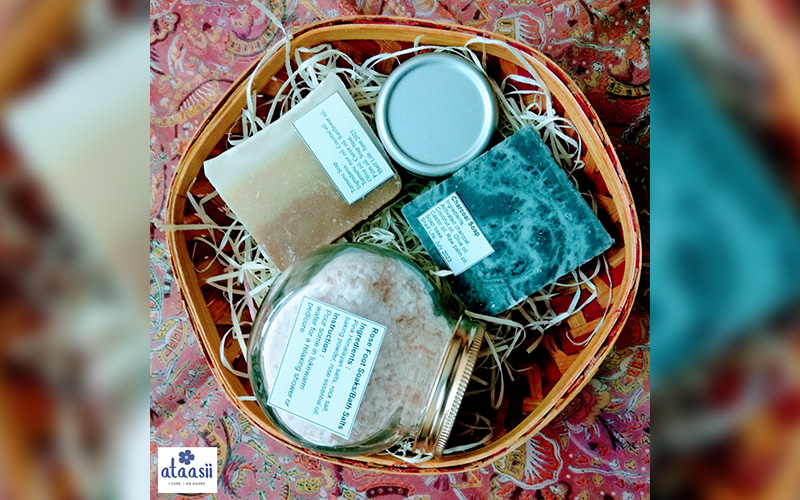
“When I created Ataasii, I wasn’t thinking business. I just wanted to talk about somethings. I felt that there was a need of a platform like this to educate people of the details we, as a world, have ignored,” Suhani recalls. Thus was formed a platform with a magazine section for people to read about various conscious practices and a store with all things natural – soaps, shaving bars, candles, body scrub, face pack, etc.

About the founder:

Prior to establishing Ataasii, Suhani worked as a communications professional with the media and corporates. Even before she founded Ataasii, she had a strong impulse for focusing on self-care. A personal trait that was hidden and needed honing became her professional calling and that’s how Ataasii came into existence.

The journey:

Ataasii started small in 2020. Really tiny. On Instagram. The idea was to establish a magazine that spoke about various aspects of conscious living. But instead of including Ads to drive the revenue, Suhani chose to attach a store that would house stuff related to the content the magazine produced. “Ads can deter the viewing and reading experience,” she confirms. Strangely, the magazine section got lost (it definitely exists) while the store gained popularity.

The journey has been organic and slow-paced. The pandemic, of course, had the world at a pause. However, the founder is not complaining. For her, “things will happen when they are meant to happen.” Her only concern is to ensure that whatever little gets done, gets done well.  

The business has been promising but fluctuating in the last one year, from when the world started moving. At times it is flourishing with corporate orders coming in. And at other times, there’s a complete standstill.

The magazine section which is more like a blog now will soon see a physical copy of all the interviews published there.  

Bottlenecks in the journey

There are and were several bottlenecks for team Ataasii. The pandemic played a spoilsport. The world was shut down and therefore they didn’t see activities taking place. It was difficult for them to stay motivated in such times.   

To interview people for the magazine, they find it hard to scout people who follow a conscious lifestyle. “This leads to delay and the delay leads to lackluster entrepreneurial attitude,” says Suhani.   

Speaking of the store, there are several players who are already established in the same genre making the buyers unsure as to why should they gravitate to a newbie brand. Also, Amazon is a competitor they can’t compete with. “It’s a losing battle,” Suhani informs. Most people naturally tend to buy products from Amazon. 

The USP

To be specific, the store is confident of the products they house. “You have to use our face pack and bath salts and the scrub and the pain relief balm, you will come back asking for more,” Says a proud Suhani. Some of these products are what she has been using on herself for years, much before they become part of Ataasii’s store. “We know what we are doing,” adds Suhani.

The Mission

The company’s mission is to document many more interviews of individuals and speak about every aspect of conscious living. With this in place, the brand aspires to have a storehouse to create far more varieties of conscious products, say a jute bag or a yoga mat. 

January 23, 2023 0 comment
0 FacebookTwitterPinterestEmail
Wellness

SVISH your way to personal hygiene

by Team Conscious Carma January 21, 2023
written by Team Conscious Carma

SVISH, one of India’s fastest-growing personal hygiene D2C start-ups has introduced a unique line of products that promise to take care of hygiene in areas that fall between the waistline and the knees in a dungeon called the underwear. Even though men have not really come around discussing their hygiene issues on any forum in any part of public sphere, SVISH has had the ‘ballz’ to not only conduct a thorough research on the subject but also introduce a line of products that are specialized to treat the sweaty and smelly areas of the scrotum like no one has ever before.

Ishan Grover and Jaideep Mahajan, the men behind SVISH, ought to be credited for thinking about the hygiene of areas of the human body that have strangely, seldom found the focus in day-to-day grooming. The unique, and first-of-its-kind men’s range of intimate hygiene products, Made in India, includes India’s 1st SVISH Ballz Foam Wash- Zero Fragrance, India’s 1st SVISH Ballz Roll on AntiChafing Deo and SVISH Intimate Wipes, the must have regime for men.

The women’s product line includes SVISH Intimate wipes, India’s 1st clutch pack which is as small as a credit card, SVISH Anti-chafing roll-ons, SVISH intimate hygiene wash and several other distinctly designed products. With superior, thoughtful, and all-natural, safe, intimate hygiene products, SVISH believes in letting women feel awesome inside, all day, every day! The range is the company’s little contribution to help women feel great about themselves while traveling, at work, at home, or through their menstrual cycles.

Availability : https://gosvish.com

January 21, 2023 0 comment
0 FacebookTwitterPinterestEmail
handamade, natural skincare
BeautySkin-CareSustainable Startup Stories

Lavanya – A  Natural Handmade Produce, from the Himalayas, Uttrakhand

by Team Conscious Carma January 20, 2023
written by Team Conscious Carma

Lavanya, a handamade, natural skincare brand from Uttarakhand, came into existence due to the skin allergy faced by  Megha Maheshwari, a hotelier and HR professional having worked with Taj group of hotels.  Her Mother in Law, Shiv Shakti Bhatnagar came to her rescue with natural homemade treatment based on Ayurveda.

“This sparked the idea of using our OWN heritage of Grand mother’s & Great Grand mother’s secrets of natural & homemade beauty recipes. Reviving forgotten recipes gave birth to Lavanya in October 2020”, says Megha

All its products are made of 100% Natural. Preservative- Free, Paraben-Free, Chemical Free, Cruelty-Free and Alcohol Free. And the raw materials are sourced under personal supervision & handpicked by Himalayan village women in Uttrakahand. These are then grinded in water mill (gharrat)

As our products are handmade there may be imperfections and their Shape, Size, Weight, Color may vary from each other but the authenticity of the raw materials is guaranteed

Challenges

There are a few challenges as every start-up faces.  We are currently creating small batches. Also, our product range is in dry powder form  and not in ready to use format as we don’t use any preservatives.  We are exploring and experimenting with available local herbs to be used as natural preservatives.

Milestones

We have sold to almost 1,000 customers till now and there is not even a single negative feedback. We are currently selling through Instagram and participating in government exhibition and through the word of mouth

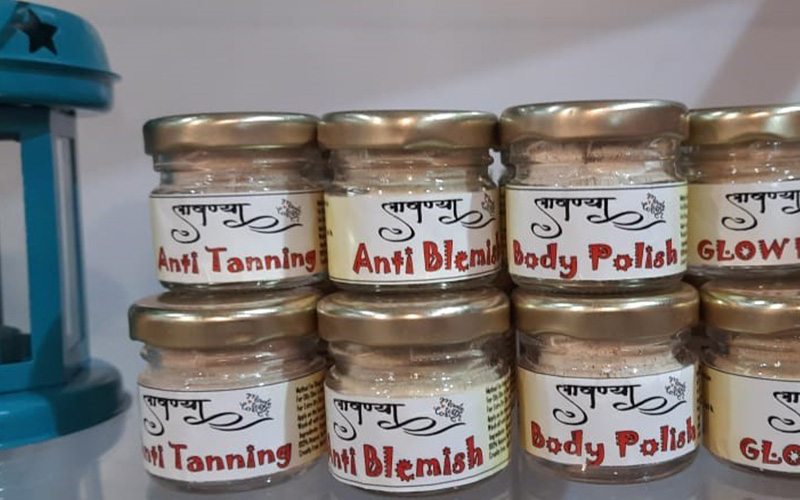
Products being offered : 15 variants of soaps, 3 variants of body and face cream, 5 variants of Lip balm, Hair Oil, 4 variants of Face Pack, Face scrub, anti-acne pack, 3 variants of lip and body scrub and face oil.  Trials are under way to introduce body oil essential oils, navel oil and face and body wash

Vision

Our vision is to bring our vedic ayurvedic science back to the modern world which has better effects than synthetic chemicals, is reasonably priced and also provide a livelihood to our Himalayan villagers and help them sustain

Availability : Instagram Lavanya.beauty.products

January 20, 2023 0 comment
0 FacebookTwitterPinterestEmail
What Design Can Do - Creatives to Build a Circular Society
EnvironmentEvents

What Design Can Do Urges Creatives to Build a Circular Society — One Great Idea at a Time

by Team Conscious Carma January 19, 2023
written by Team Conscious Carma

What Design Can Do (WDCD),  an international platform that advocates for design as a tool for social change since 2011, launched an ambitious design challenge programme in 2016 that engages the creative community with urgent societal issues such as the wellbeing of refugees and climate change. So far, the programme has resulted in €10m in funds raised by initiatives post programme. 

Their Fourth Challenge  Make it Circular Challengein partnership with the IKEA Foundation is inviting designers and creative entrepreneurs globally to submit design-driven innovations from 11 October 2022 – 31 January 2023.

When it comes to the climate crisis, there’s no time for cynicism. With millions of people already experiencing the effects of a warming planet first hand, we need to move forward with optimism and momentum. This is the driving force behind this challenge which is inviting solutions from all innovators — from designers to entrepreneurs — to submit their boldest climate solutions using circular design.

Winning proposals will be made into reality with an impact-driven development programme. The end goal? To create products, services and systems that are both user-centred and earth-centred, showing that a circular future is not only imaginable — but actionable.

THE HIDDEN POWER OF CREATIVITY

Most economies today are based on a linear model, where value is created by producing and selling as many products as possible. The problem is, it operates on the assumption that infinite growth is possible on a finite planet. Today, we are seeing just how wrong this assumption was, as we face an accelerating climate crisis. Yet when looking ahead at the route to a circular society, many people only see obstacles that they would rather not or cannot take on. One of the most important challenges is to convince them that we can create a new world which makes our lives not less but even more fulfilling.

circular society conscious carma

“Many people become lost in the face of so much outrage, fatigue and disinterest — but not creatives,” says Richard van der Laken, co-founder and creative director of WDCD. “The ability to imagine is the creative community’s ideal domain: seeing what does not yet exist, taking on a challenge, forging ahead with optimism.”

The challenge is released and executed in India by local amplification partners UnBox Cultural Futures Society and research partners, Quicksand Design Studio. 

“The Make it Circular Challenge shows how it is possible to use creative design practices to rethink our current problems, and address the most pressing needs in order to create a more equitable future for all. Our partnership with What Design Can Do will bring to designers and creative entrepreneurs an opportunity to drive meaningful change by submitting their radical climate solutions using actionable circular design principles,” says Ayush Chauhan, Managing Partner & Co-Founder, Quicksand Design Studio & UnBox Cultural Futures Society. Quicksand Design Studio is an interdisciplinary creative consultancy facilitating the creation of meaningful experiences through design research and innovation.

A jury of leading experts in design, social impact and climate action will select a minimum of 10 winners. Winning ideas are turned into reality with €10.000 in funding and a global development programme co-created with Impact Hub Amsterdam, which includes online training, mentoring sessions and a bootcamp. This programme will support the winning teams in further strengthening their projects, and propelling them through 2023 and beyond.

The Make it Circular Challenge is active in six countries around the world: Kenya Japan, Brazil, India, Mexico, and Netherlands.

For more information, visit www.whatdesigncando.com 

January 19, 2023 0 comment
0 FacebookTwitterPinterestEmail
EconomyEnvironment

Indian govt approves National Green Hydrogen Mission

by Team Conscious Carma January 6, 2023
written by Team Conscious Carma
  • Aims to make India a Global Hub for production, utilization and export of Green Hydrogen and its derivatives
  • Will help in India becoming energy independent and in Decarbonisation of major sectors of the economy

India has taken a big leap towards its climate action goals with the Union Cabinet, chaired by the Hon’ble Prime Minister Shri Narendra Modi, approving National Green Hydrogen Mission.  The initial outlay for the Mission will be  Rs.19,744 crore.

The components of the mission include an outlay of Rs.17,490 crore for the SIGHT  programme, Rs.1,466 crore for pilot projects, Rs.400 crore for R&D, and Rs. 388 crore towards other Mission components. The allocation is expected to attract huge investments and encourage R&D, focussed on electrolysers, in the next few years.  Ministry of New & Reneawable Energy (MNRE) will formulate the scheme guidelines for implementation of the respective components.

Following likely outcomes by 2030:

  • Development of green  hydrogen production capacity of at least 5 MMT (Million Metric Tonne) per annum with an associated renewable energy capacity addition of about 125 GW in the country
  • Over Rs. Eight lakh crore in total investments
  • Creation of over Six lakh jobs
  • Cumulative reduction in fossil fuel imports over Rs. One lakh crore
  • Abatement of nearly 50 MMT of annual greenhouse gas emissions

“The Mission will have wide ranging benefits- creation of export opportunities for Green Hydrogen and its derivatives; Decarbonisation of industrial, mobility and energy sectors; reduction in dependence on imported fossil fuels and feedstock; development of indigenous manufacturing capabilities; creation of employment opportunities; and development of cutting-edge technologies.  India’s Green Hydrogen production capacity is likely to reach at least 5 MMT per annum, with an associated renewable energy capacity addition of about 125 GW.  The targets by 2030 are likely to bring in over Rs. 8 lakh crore investments and create over 6 lakh jobs.  Nearly 50 MMT per annum of CO2 emissions are expected to be averted by 2030”, according to an official statement on the cabinet’s decisions.

The Mission will facilitate demand creation, production, utilization and export of Green Hydrogen.  Under the Strategic Interventions for Green Hydrogen Transition Programme (SIGHT), two distinct financial incentive mechanisms – targeting domestic manufacturing of electrolysers and production of Green Hydrogen – will be provided under the Mission.  The Mission will also support pilot projects in emerging end-use sectors and production pathways.  Regions capable of supporting large scale production and/or utilization of Hydrogen will be identified and developed as Green Hydrogen Hubs.

Unlike grey hydrogen which uses natural gas, green hydrogen is produced by the electrolysis of water using renewable energy and thus doesn’t emit carbon dioxide into the atmosphere.

January 6, 2023 0 comment
0 FacebookTwitterPinterestEmail
Spirituality

Vedic Culture is a precise Science

by Team Conscious Carma December 29, 2022
written by Team Conscious Carma

The Vedic culture is a very scientific and precise science; science of the entire creation and the science of being,  as a microcosm of the macrocosm, which is the physically manifested creation. It very clearly lays down the path and also how to walk on it and provides tools and techniques such that the secrets of the creation are revealed to you; so that the final merger happens with full consciousness in a disease-free body… at will.

The reason why there are so many seekers and very few who achieve success is simple. Those who achieve success have three things in common – a Guru who has the traits of five yamas of ashtang yog, priority to the subject over other things in life and, regular practice along with service and charity.  The above three things are tied into the framework of four ashrams – brahmcharya, grihasta, vaanprasth and sanyaas. Each of these ashrams naturally flows into the next, it is not forced, the right practice of yog under a guru ensures this.

Vaanprastha is not renunication

I will give a little insight into the vaanprastha stage for a yog-guru. Normally people think that it is renunciation, but there is no such thing as renouncing the world. One goes through it like a ship goes through the ocean, it is on the water and crosses the water, but is not in it and so it does not sink. Vaanprastha simply means to begin the process of limiting your interactions with the mundane aspects of life, and with people whose priority is not yog. In vaanprastha, teachings continue and interactions with sadhaks go on. It can be called that the ship is in the middle of the ocean and is moving towards its finality. Those on the ship are limited as only those who trust the ship fully are allowed. How long you have known the ship (guru) is of no consequence, your desire and other prerequisites are important.

Having collected the force within for the onward journey in the years of brahmcharya and having gone through the experiences of a worldly life as a grihasta, a being takes a step back from the physical world as he enters vaanprastha, because to reach the final destination, all this has to be left behind. For a rocket to break the pull out of gravity, it has to leave its excess weight. Leaving does not imply running away, the thought of the physical has to go.

Let me explain this with the help of the example of a rishi who left his family and house to do dhyan in Himalayas. The rishi followed a niyam of offering milk to the shivling every day. As he went to the Himalayas, commoners from nearby villages would bring him milk and he would carry on with his practice. Once no one came to give the milk. In the absence of milk, the rishi offered water to the shivling. However, it soon became a common occurring, the villagers would often forget to bring him milk. The rishi then decided to keep a cow so that he does not have to depend on the villagers. When he went to village to get the cow, the villagers advised him to also take a lady with him to take care of the cow as he would be in dhyan for long hours. The rishi agreed. Five years passed. The villagers then asked the rishi to marry the lady since no one else would take her. The rishi agreed. He married her and they had a family. So, whatever he had left, was created back again for him because of his one thought. That is why it is said, ‘yogah chitt vritti nirodh‘. One needs to silence the modifications of the mind to access what lies beyond the five senses. Vaanprastha is preparatory stage, which further leads to sanyas.

After a stage a yogi needs to limit his/her interactions with normal people. There is a story in the Mandukya Upanishad about a group of rishis who used to live in Himalayas. One day these rishis suddenly realised that their bodies had started ageing. (A Yogi’s body does not age. He/she leaves the body in full consciousness and strength, being aware of where he/she is going.) The rishis then had a discussion on the possible reasons for ageing. They realised that this happened as they left their Himalayan abode to settle in the villages resulting in increased interactions with normal people.  When you have interaction with normal people, there is intermingling of thoughts and energy patterns. And then the body begins to exhibit the symptoms of a normal human being – eat, drink and make merry. Vedic masters say, and modern science agrees that every action has an equal and opposite reaction. When you resort to pleasures of the five senses, as an equal and opposite reaction, the body begins to age. This ageing has to be held back to garner the energy to make the final journey beyond the five senses and also take the deserving shishyas beyond. So during the phase of vanprastha, you limit your interactions otherwise the body ages very fast.

Traits of a Guru

Now let me give you the traits of a guru – a Guru is someone who does not charge you a fee because someone who is him/herself tied in maya cannot release you, he/she exudes the glow and attraction associated with yog,  diseases disappear in his/her presence, whatever he/she says happens, and he/she is sthir in the five yams. So my suggestion is look for a guru, give the subject priority and you will be called on board on this beautiful journey called yog.

December 29, 2022 0 comment
0 FacebookTwitterPinterestEmail
SustainabilityTravel

First Ten Hotels in the world to attain LEED Zero Carbon Certification are from the ITC Hotels Group

by Team Conscious Carma December 28, 2022
written by Team Conscious Carma

Paving the way for the Global Hospitality Industry, in a one of its kind remarkable feat, 10 properties of the ITC Hotels Group have attained “Net Zero Carbon Status” by achieving coveted “LEED Zero Carbon Certification”by USGBC [United States Green Building Council]

This achievement reaffirms ITC Hotels commitment to responsible luxury and sustainability. Already, ITC Hotels is the world’s largest chain with the maximum number of LEED Platinum certified properties as per USGBC.

Anil Chadha, Divisional Chief Executive, ITC Hotels said, “Responsible Luxury is our guiding ethos at ITC Hotels. We endeavour to create planet positive experiences. The Net zero project aligns with India’s vision of significantly cutting emissions and are a critical driving force behind the transformation of buildings, cities and communities to continue to sustain future generations.”

LEED Zero, developed by the U.S. Green Building Council, is a complement to LEED that verifies the achievements of net zero goals and signals market leadership.

The first ten hotels in the world to have achieved this landmark are:

1.       ITC Windsor, Bengaluru       (1st Hotel in the World)
2.       ITC Grand Chola, Chennai   (2nd & Largest Hotel in the World)
3.       ITC Gardenia, Bengaluru      (3rd Hotel in the World)
4.       Welcomhotel Bengaluru        (4th Hotel in the World)
5.       Welcomhotel Guntur             (5th Hotel in the World)
6.       Welcomhotel Chennai           (6th Hotel in the World)
7.       ITC Mughal, Agra                 (7th Hotel in the World)
8.       Welcomhotel Coimbatore     (8th Hotel in the World)
9.       Welcomhotel Sheraton New Delhi (9th Hotel in the World)
10.     ITC Grand Central, Mumbai (10th Hotel in the World)

LEED Zero Carbon Certification recognizes buildings operating with Net Zero Carbon emissions on annual basis. The certification provides a transparent accounting of the carbon balance i.e. carbon emitted due to Energy consumption and occupant transportation v/s Carbon avoided to achieve Net Zero Certification, entity’s carbon balance should be either ‘0’ or -ve. [Carbon Balance = Total Carbon Emitted – Total Carbon Avoided]

At a time when the world is closely monitoring and benchmarking the carbon emissions by each and every sector, this achievement by the ITC Hotels group is a big global step towards Sustainability.

December 28, 2022 0 comment
0 FacebookTwitterPinterestEmail
EconomySustainability

Is Sustainability the future of Indian Textiles?

by Team Conscious Carma December 27, 2022
written by Team Conscious Carma

Intro: Spinning sustainable textiles is the way forward if we want to save the rivers and planet. Indian handlooms will always be high on sustainability! Celebrating eco-friendly fabrics and fashion is the future!

Nona Walia – Will sustainability be the big trend in textile and fashion industry in 2023. We are moving in a world where people want to make more conscious choices in their personal space. Spinning a green yarn has been one of the oldest traditions in India. The slow woven cloth on the loom was one of the first lessons in sustainable fashion.

We are already witnessing a handloom boom in 2022, handwoven handlooms are high on sustainable textiles. India’s handloom love story took a new twist after 2018, when bloggers and influencers started making their love for handlooms fashionable again on Instagram, #handloom has 4.2 million posts on Instagram. The handlooms are now fast becoming heirloom pieces to flaunt on social media. 

Be it Chanderi or Paithani or Patola — every handloom tells a story. Every woman must own and be proud of her handwoven handlooms. Handlooms are a story in sustainability. From dyeing, weaving and printing techniques, threads, handmade traditions, India’s handloom story is historic. The skills of block-printing, embroidery and weaving (like shawls) has a global demand. From khadi to chikankari to Mulmul — Indian textiles have always been sustainable. Meghalaya’s weavers use sustainable natural dyes. Even the Ajrak workers in Ajrakpur use natural dyes. Around 20% of industrial water pollution in the world comes from treatment and dyeing of textiles, and about 8,000 synthetic chemicals are used to turn raw materials into textile. We need to recreate old slow methods of producing textiles. Batik workers are finding it extremely challenging to exist in the age of digital printing which is not sustainable.

Original batik workers use only natural dyes. India’s cotton industry is polluting rivers and the environment. A return to traditional handlooms, natural dyes could make a difference. A big step would be to return to handwoven and handspun clothes. A big leap forward would be to also wear undyed fabrics. Says Deepshika Kalsi, textile conservation expert and historian, “Indian Textiles have been sustainable in their conscious approach of fabrication and end use at every stage. We have now coined the term slow fashion, whereas it was the way of life earlier. From seeding/harvesting/cultivating natural fibres, hand spinning of thread, use of natural dyes and production processes that wouldn’t pollute the rivers. Hand woven on loom. Every stage was time consuming. The key word here is consume! Water wasted in production processes, use of synthetic dyes and microfibres released from synthetic textiles after each washing cycle, tons of textiles ending up in landfills is alarming. We need to promote sustainability in textiles.”

India has one of the world’s major textile industries, estimated to be worth more than $209 billion by 2029. Here are some women who worked for sustainability and longevity for artisans and textile craft at the grassroots level.

Jasleen Dhamija, India’s first textile art historian, crafts expert and former UN worker. She has remained faculty at the National Institute of Fashion Technology, New Delhi, where she taught History of Indian Textiles and costumes. In her book Handwoven Fabrics of India, Edited by Jasleen Dhamija and Jyotindra Jain she writes, “The largest number of handlooms in the world operated in India, where 4 million looms occupy a workforce of apporx 10 million people.” She documents India’s weaving and textile history. In another article on Indian Velvets, Dhamija studied rare explanations of techniques to produce different velvets:voided velvets, ikat velvets, terry velvets…. Her passion project has been the Punjabi Phulkari.

Deepika Govind, who’s worked for years to create the ‘Eri-Peace Silk’ which is non-violent. Says Deepika, “I wanted to invent silk that did not harm any life form and was sustainable. The Ahimsa fabric till now was rough and expensive. We used a technique where the Eri cocoons are open-ended, thus allowing the moth to fly to freedom.” Besides silk, people are using other sustainable fabrics are organic cotton with no pesticides, linen made from flax.”

Sally Holkar, has been working with sustainable heritage fabrics for four decades – Maheshwari and Chanderi. “It was a time when traditional patronage lapsed. Almost 300 weavers were on the brink of extinction. Today, there are 3,000 weavers of Maheshwari fabric. I wanted to restore and revive the art of sustainable textiles.”

Pranavi Kapur has a lifetime of passion for Indian handlooms and textiles. Her passion for Khadi has been a lesson in Sustainable fabrics. She has used multiple textile techniques in creating new fabrics. Working closely with the ground level weavers, she has worked on — ikat loom from Andhra Pradesh; Khatris of Bhuj for bandhani and Bengal karigars. Every new weave is a stitch in history, reviving and restoring past legacy of treasured textiles some which are unique and becoming extinct. Says Pranavi, “Sustainable practice in textile production has been precious to me while creating a new fabric yarn or outfit. That’s the reason, I’ve worked a lot with Khadi.”

December 27, 2022 0 comment
0 FacebookTwitterPinterestEmail
Newer Posts
Older Posts

Recent Posts

  • India–UK Free Trade Agreement Opens Global Growth Opportunities for 3R ZeroWaste’s Circular Economy Solutions
  • Plastic Free July: Why True Sustainability Goes Beyond Swapping Plastic
  • From the Editor’s Desk: When Greed Takes Over Conscience
  • Beyond the Pose: Why Your Yoga Mat Needs a Sustainable Upgrade
  • Best Sustainable Father’s Day Gifts: Conscious Carma’s Exclusive Picks

Recent Comments

  • Team Conscious Carma on Label Shivika Agarwal – where craft meets sustainability
  • Cocomeister.jp on Label Shivika Agarwal – where craft meets sustainability
  • Team Conscious Carma on Equitable City Designs To Fight Climate Change
  • UN report calls for repurposing of USD 470 billion of agricultural support that distorts prices and steer us away from environment and social goals | Consciouscarma on UNEP & ICMR collaborate to boost understanding of environmental dimensions of antimicrobial resistance in India
  • Wild Earth : Natural body products | Consciouscarma on Sat.Suma : the true essence of flowers in your everyday skincare needs

Keep in touch

Facebook Twitter Instagram Youtube

Recent Posts

  • India–UK Free Trade Agreement Opens Global Growth Opportunities for 3R ZeroWaste’s Circular Economy Solutions

  • Plastic Free July: Why True Sustainability Goes Beyond Swapping Plastic

  • From the Editor’s Desk: When Greed Takes Over Conscience

  • Beyond the Pose: Why Your Yoga Mat Needs a Sustainable Upgrade

  • Best Sustainable Father’s Day Gifts: Conscious Carma’s Exclusive Picks

  • How Sacred Sound is Reshaping the Future of Holistic Health?

Categories

  • Community (38)
    • Campaigns (3)
  • CSR (4)
  • Economy (82)
    • Global (24)
    • Industry (42)
    • Innovations (4)
    • National (2)
  • Environment (48)
  • Expert Corner (48)
    • Authored Articles (47)
  • Featured (5)
    • Partners (1)
  • Global News (2)
  • Initiatives (31)
    • CSR (3)
    • Events (6)
  • Inspiration (22)
  • Lifestyle (9)
  • Media Coverage (6)
  • Press Releases (4,358)
  • Products (126)
    • Accessories (27)
    • Apparel (32)
    • Beauty (26)
    • Food (4)
    • Gifting (3)
    • Home Décor (15)
    • Skin-Care (14)
  • Reports (3)
  • Spirituality (10)
  • Sustainability (49)
  • Sustainable Startup Stories (28)
  • Travel (19)
  • Uncategorized (2)
  • Wellness (33)
    • Home Cleaners (3)

Archives

  • August 2026 (1)
  • July 2026 (1)
  • June 2026 (6)
  • October 2024 (1)
  • September 2024 (1)
  • July 2024 (2)
  • June 2024 (2)
  • May 2024 (1)
  • November 2023 (330)
  • October 2023 (554)
  • September 2023 (631)
  • August 2023 (718)
  • July 2023 (723)
  • June 2023 (710)
  • May 2023 (608)
  • April 2023 (114)
  • March 2023 (7)
  • February 2023 (3)
  • January 2023 (11)
  • December 2022 (18)
  • November 2022 (1)
  • August 2022 (6)
  • July 2022 (8)
  • June 2022 (24)
  • May 2022 (11)
  • April 2022 (19)
  • March 2022 (11)
  • February 2022 (11)
  • January 2022 (14)
  • December 2021 (10)
  • November 2021 (4)
  • October 2021 (14)
  • September 2021 (22)
  • August 2021 (12)
  • July 2021 (17)
  • June 2021 (17)
  • May 2021 (16)
  • April 2021 (22)
  • March 2021 (33)
  • February 2021 (16)
  • January 2021 (22)
  • December 2020 (10)
  • Facebook
  • Twitter
  • Instagram
  • Pinterest
  • Linkedin
  • Youtube

@2020 - All Right Reserved. Designed and Developed by Bizopser Technologies

Consciouscarma
  • Home
  • About Us
  • Products
  • Community
    • Campaigns
    • Inspiration
    • Initiatives
    • CSR
  • Features
    • Sustainable Startup Stories
    • Travel
    • Lifestyle
    • Partners
  • Economy
    • Industry
    • Innovations
    • National
    • Global
  • Environment
  • Expert Corner
    • Authored Articles
    • Reports
  • Magazine
  • Contact