Consciouscarma
  • Home
  • About Us
  • Products
  • Community
    • Campaigns
    • Inspiration
    • Initiatives
    • CSR
  • Features
    • Sustainable Startup Stories
    • Travel
    • Lifestyle
    • Partners
  • Economy
    • Industry
    • Innovations
    • National
    • Global
  • Environment
  • Expert Corner
    • Authored Articles
    • Reports
  • Magazine
  • Contact
Monthly Archives

May 2021

toyota eneos woven planet
EconomyIndustry

ENEOS and Toyota Come Together to Make Woven City the Most Hydrogen-Based Society

by Team Conscious Carma May 10, 2021
written by Team Conscious Carma

The “human-centred” city of the future aims to become fully carbon-neutral

ENEOS Corporation (ENEOS) and Toyota Motor Corporation (Toyota) announced that they have agreed on a new partnership to explore the utilization and application of hydrogen energy at Woven City, the prototype city of the future that Toyota has started to develop in Susono City, Shizuoka Prefecture. ENEOS and Toyota, together with Woven Planet Holdings (Woven Planet), a subsidiary of Toyota, leading the Woven City project, intend to conduct testing and demonstration in areas related to a hydrogen-based supply chain, from production, delivery to the usage of hydrogen, in and around Woven City. Through this effort, they aim to help achieve a carbon-neutral society by 2050 as Japan and many other countries around the world have committed.

ENEOS is a leading company in the hydrogen business, operating 45 commercial hydrogen refueling stations in the four major metropolitan areas in Japan. In anticipation of a fully hydrogen mass-consumption society and to promote the overall low-carbon use of energy, ENEOS is also developing technologies that facilitate hydrogen production and building an entire supply chain based on CO2-free hydrogen.

Positioning hydrogen as one of the most viable clean energy sources in the future, Toyota has invested in hydrogen and fuel cell technology and its popularization through efforts to apply the technology in various mobility including passenger cars, commercial vehicles, industrial vehicles (e.g. forklifts), trains, and ships, as well as stationary generators.

The aim of this project is to build a society in which people can enjoy a happy, healthy, and sustainable life. Through this partnership, the companies are leveraging each other’s expertise and experience to fully explore hydrogen’s potential. At Woven City, they intend to promote carbon neutrality in everyday mobility, people’s lives, and within the infrastructure of the city itself as well as to raise awareness of hydrogen among resident families and visitors.

Katsuyuki Ota, president of ENEOS said, “We strongly support Toyota’s bold vision for demonstrating technologies of the future through Woven City and are delighted to participate in the project. We believe that hydrogen energy will play an integral role in the realization of carbon neutrality on a global scale and that Toyota is at the forefront of developing a fully hydrogen-based society. By working together with Toyota to fully explore hydrogen’s potential, we believe we can make a significant contribution to the creation of new hydrogen-based lifestyles. I sincerely hope that by demonstrating Woven City’s approach across the globe, we can accelerate our progress toward a new, more sustainable energy future.”

Akio Toyoda, President and CEO of Toyota Motor Corporation, said, “We are very pleased to have ENEOS as our core partner to validate the hydrogen society in Woven City. As Japan’s leading integrated energy company, ENEOS has demonstrated its valuable expertise in all vital processes from hydrogen production to sales and we are confident they have the holistic perspective we require for success. To realize a hydrogen-based society, in addition to the evolution of individual technologies, it is essential to seamlessly integrate all the processes of production, delivery, and use. We will continue to work with ENEOS and the local community to develop the base unit of hydrogen throughout Japan and around the world. Our “Human-Centered approach” to the real world of Woven City will help us fully explore the practical details of hydrogen-based lifestyles and technologies.”

Woven City is pioneering a profound evolution in how societies of the future will live, work, and play. Three fundamental concepts are critical to its development; “Human-Centered” respect for individuals and prioritization of their needs and preferences; “Living Laboratory” which enables seamless real-world testing of new technologies such as hydrogen; and an “Ever-Evolving city” in which such new technologies and services continuously grow and improve.

Together with ENEOS and many other like-minded companies, researchers, and inventors around the world, Toyota and Woven Planet are working to accelerate their efforts to build a city for happiness.

Source: https://www.woven-planet.global/

Note: The content has been edited for style and length

May 10, 2021 0 comment
0 FacebookTwitterPinterestEmail
Economy

Sikkim: The FIRST 100% organic state in the world

by Team Conscious Carma May 8, 2021
written by Team Conscious Carma

The picturesque Himalayan state of Sikkim, located in northeast India, on the border with Bhutan, Tibet, and Nepal, is World’s First Organic State. All of its farmland is certified organic.

Sikkim won the golden Future Policy Award 2018, conferred by the Food and Agriculture Organisation of the United Nations (FAO) and IFOAM, for the world’s best policies promoting agroecological and sustainable food systems, beating 51 nominated policies from 25 countries.

In 2003, Chief Minister Pawan Chamling announced the vision for Sikkim to be India’s first organic state. Sikkim became the first state in India to officially announce the adoption of organic farming to ensure long term sustenance of soil fertility, protection of environment and ecology, healthy living and decreasing the risk of health ailments.

The state government showed strong political will and policy coherence, along with well-defined targets and implementation plans. The policy combined mandatory requirements, such as gradually banning chemical fertilizers and pesticides, with support and incentives to build a holistic transformation of the whole Sikkimese food system.

The policy also focused on enhancing soil fertility, preserving water quality and increasing biodiversity at the field and landscape level. Training farmers in how to produce organic inputs such as compost, vermicompost and organic pesticides using local plants.

Sikkim thus returned to traditional methods of farming based on inter-connection between humans and nature. After a 13 year trial, Sikkim is now boasting an increased bee population, butterflies, more wildlife, larger yields and healthy soils. The state is not only preserving its rich biodiversity and fragile ecosystem, it is also showing the world that a small state can lead us into a greener and organic future.

Sikkim’s transition to a fully organic state has benefited over 66,000 farmers, reaching beyond just organic production to include socioeconomic aspects such as consumption and market expansion, rural development and sustainable tourism with its comprehensive and inclusive approach. As such, Sikkim is an excellent model for other Indian states and countries worldwide who want to upscale agroecology.

The Sikkim tourism sector also benefitted greatly from the state’s transition to 100 per cent organic as the number of tourists increased by over 50 per cent between 2014 and 2017. The transition not only increased the income but also the life expectancy of its entire population. In 2016, Sikkimese people lived ten years longer than in 1990 and the state administration has data showing the connection with healthy organic biodiverse food.

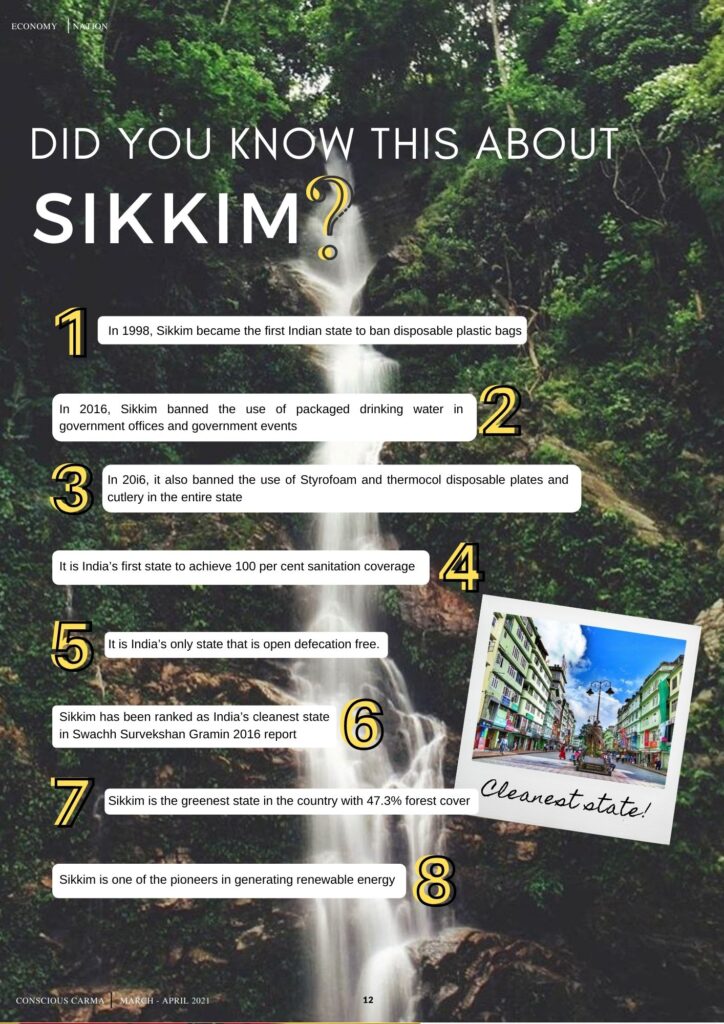
In the past two decades, Sikkim has become a pioneer in sustainable development. It is a state with many firsts when it comes to green policies. In 1998, it became the first Indian state to ban disposable plastic bags, it is also among the first to target single-use plastic bottles. “What happened was that in one episode in the 1990s, plastic carry bags got washed down due to heavy rainstorm. Drains got blocked, which resulted in a huge landslide. Some people died too. This triggered the state government to ban plastic bags,” said Rajendra P Gurung, CEO, Ecotourism and Conservation Society of Sikkim (ECOSS), a local NGO that works in Sikkim. In 2016, Sikkim took two major decisions. It banned the use of packaged drinking water in government offices and government events. Second, it banned the use of Styrofoam and thermocol disposable plates and cutlery in the entire state in a move to cut down toxic plastic pollution and tackle its ever-increasing garbage problem.

The state has another distinction—that of

Minimum diversion of 800 hectares of forest land for non-forestry purposes in the last 20 years.

It is also India’s first state to achieve 100 per cent sanitation coverage and the only state that is open defecation free. Urinating in public can cost Rs 500 ($7.50). The government made it mandatory to have a sanitary toilet at home to be eligible for any benefits from the government or to contest in village-level elections. This has resulted in the success of the programme which was envisaged years before Swachch Bharat Campaign (Clean India Campaign) was even conceptualized. In fact according to the Swachh Survekshan Gramin 2016 report Sikkim has been ranked as India’s cleanest state, based on the sanitation of its rural areas.

Sikkim is also the greenest state in the country. The forest cover based on interpretation of satellite data is 3,359 sq km which is 47.3 per cent of state geographical area as compared to 21 per cent of the national average. The Sikkim government has spent around Rs 10 crore on green mission so far and around 45 lakh indigenous trees, shrubs, herbs, climbers, creepers, conifers and green foliages including fruits and medicinal plants have been planted under the green mission to create a store house of genetic diversity.

Several protection and conservation programmes such as Sikkim green mission, Smriti Vans and Ten Minutes to Earth have been launched by the State. Under the “Ten Minutes to Earth” mission launched in 2009, 6,10,694 saplings were planted throughout the state in ten minutes, creating a new world plantation record. This greenery has helped in the sequestration of 1400 tonnes of carbon dioxide annually. Now, every year, on June 25, ten minutes are dedicated to a mass plantation drive.

Sikkim is on the road to attaining almost full literacy

The state even banned firecrackers in 2014 to contain noise and air pollution.

The state is also one of the pioneers in generating renewable energy.

It has a total installed power generation capacity of 674.43 MW. Of the overall installed power generation capacity in the state, thermal power contributes 102.25 MW, while hydropower and renewable power contributes 520 MW and 52.18 MW, respectively.

The state is also considered to be the Kingdom of flowers and is an innovator in cultivating Gladiolus

The state is richly endowed with rare and exotic flora and fauna, which includes 5,000 species of flowering plants, 515 rare orchids, 60 primula species and 36 rhododendron species. Of the 6,000 medicinal plants in India, over 424 plants (including the famous Artemisia vulgaris that is used as an antiseptic) are grown in Sikkim

Under the “Ten Minutes to Earth” mission launched in 2009, 6,10,694 saplings were planted throughout the state in ten minutes, creating a new world plantation record.

Sikkim has several snow-capped peaks including Khangchendzonga National Park, one of the most sustainable tourist destinations in India. A UNESCO World Heritage Site and India’s only Mixed Heritage site, this magnificent place is famous for both its cultural and natural heritage and is home to Kanchenjunga peak. Also, a home to red pandas and snow leopards, the park covers around a fourth of Sikkim’s area and borders both Nepal and China. Almost half of India’s bird species and one-third of the country’s flowering plants are found within this park.
Once considered to be one of the poorest states in India with 35 per cent of the people living below the poverty line, Sikkim now stands amongst the top income-generating states with a substantially low level of poverty. The Gross State Domestic Product (GSDP) of Sikkim expanded at a high CAGR of 15.86% between 2015-16 and 2019-20.

Sikkim is the only state which offers excise benefits and major players from the pharmaceutical industry have set up their manufacturing units in the state. A few of these are Cipla, Sun Pharma, Zydus Cadila, Alembic, IPCA, Alkem Lab, Intas Pharma, Torrent Pharmaceuticals, and Unichem.

The state attracted Foreign Direct Investment (FDI) equity inflow worth US$ 5.85 billion during April 2000 and September 2019 according to the data released by the Department for Promotion of Industry and Internal Trade (DPIIT).

With a population of under seven lakh, the tiny state of Sikkim has been leading a green revolution of its own kind. Despite being small and isolated, and with its people leading their lives in extremely tough mountainous terrain, Sikkim has emerged as one of India’s environmental leaders.

Checkout the rest of the magazine from here

May 8, 2021 0 comment
0 FacebookTwitterPinterestEmail
jadav payeng
CommunityInspiration

Saluting the Awakened Soul: Jadav Payeng, Forest Man of India

by Team Conscious Carma May 6, 2021
written by Team Conscious Carma

Created 550 hectares of forest single-handedly on barren land in Assam

A 16-year-old young tribal boy, Jadav Payeng was deeply hurt to see hundreds of dead snakes lying on the sandbar in the heat after being washed away by the Brahmaputra river floods during monsoon at Majuli, the world’s largest river island in Kokilamukh of Jorhat District, Assam.

He wondered what it would look like if the same happened to humans and asked the tribal people in a nearby village what he could do? They told him to plant trees, particularly bamboo since they could withstand harsh conditions and gave him 25 saplings and some seeds.

What Jadav did on that hot day, driven by something that tugged at his heart and scared him in equal measure, turned out into 550 hectares of forest, home to 120 species of birds, elephants, rhinos and tigers, etc and won him national and international recognition.

The power of a single human being

His compassion for each living being on the earth, coupled with years of dedication and hard work, shows how even ONE SINGLE INDIVIDUAL can turn around the situation. He left his studies, married late and worked tirelessly and single-handedly for 30 years to turn the barren land into a lush green forest, officially named Molai forest, after his nickname Mola.

Jadav was conferred the title “The Forest Man” by the Government of India on World Health Day 2010. In 2015, he was honoured with Padma Shri, the fourth highest civilian award in India. He also received the 128th Commonwealth Points of Light Award from the Queen of England in March 2020 for his unending efforts to promote aforestation.

Jadav, however, refuses to take the credit. “The birds, cows, deer, wind, water and elephants have helped me. People want to know my story. I tell them I just plant trees, and I would like all of you to do so. Trees are the lifeline of the forest, they don’t just give us shade and oxygen, they feed birds and animals and balance our ecosystem. If there is no life left, what is the use of all the advancements we have made?”

jadav planting trees

The words of wisdom

After numerous visits to speak at schools and colleges, Jadav is dismayed that World Earth Day has been celebrated in the same manner for the past 30 years. Explaining how it takes five years of tender love and care for a sapling to turn into a tree, he says, “It will be a beautiful thing if a child is taught to plant a sapling or a seed when he is initiated in school and as he grows up, he or she is taught to take care of it and be responsible for it. If this had been done 30 years back by all of us, would global warming and climate change have dared to touch us?”.

The human greed

He lives in a small hut in the forest with his wife and 3 children and for his livelihood, he sells cattle and buffalo milk, which is his only source of income. In an interview in the year 2012, he revealed that he has lost around 100 of his cows and buffaloes to the tigers in the forest, but blames the people who carry out large scale encroachment and destruction of forests as the root cause of the plight of wild animals.

One threat which he deals with every day, – not nature but MAN. Poachers have an eye on his forest and its inhabitants, however, the local Forest Department authorities are providing him with enough protection and support for the same. There is this one man who has single-handedly given life to several hundreds of living beings and then there are men who, for their personal greed, are poaching them.

The humility

There are several documentaries being made on him, also a film with famous film star Rana Daggubati as Jadav and children’s book and also he finds a place in US school curriculum. He has been invited by a Mexican non-profit organization to guide them to raise more trees in Mexico.

Despite all this, Jadav does not see himself as a celebrity, nor does he care about the laurels he has earned. ‘Reading about me is not enough. Do what I do. I want school teachers to follow up on my chapter with tree-planting sessions, and to teach children to nurture and grow them with love and care,” says the humble and true environmentalist Jadav.

Checkout the article in our magazine from here

May 6, 2021 0 comment
0 FacebookTwitterPinterestEmail
insurance
Authored ArticlesExpert Corner

Ensuring equity in the domestic business environment: The Pandemic Insurance Pool

by Team Conscious Carma May 4, 2021
written by Team Conscious Carma

The second wave of this ongoing pandemic might force the administration to opt for total lockdown, as it happened in the mid of 2020. The partial lockdown is already effective in many otherwise bustling cities and industrial towns to keep the spread of Covid-19 under control. India is an aspiring High-income country, and for many of us, lifeline (Salary & Wages) is as essential as our lives. The lockdown will reduce the overall consumption in the economy, which is already growing at a snail speed. It is crucial to inject money into businesses to compensate for cash flow disruption caused by the lockdown. Such economic interventions will minimize business failures, ensure employment, and secure jobs. The cash transfers stated above can be funded through innovative insurance policies for industry and off-loading partial risk to the government.

The incidents like 9/11 rerouted the natural course of global reinsurers by opting out of terrorism insurance. However, countries like India with a narrow insurance consumer base came up with creating a terrorism risk insurance pool. Terrorism cover was given as an add-on to the existing property insurance policies. Over the years, this insurance had generated a pool of Rs 2000 cr. It also covered the terrorist attack on businesses such as November 26th, when the iconic Taj Mahal Palace Hotel and the Trident suffered severe property and business losses in Mumbai. Likewise, the insurance industry has come up with a nuclear insurance pool in 2015 to cover the nuclear operators and suppliers to cover corporate liability or losses. This six-year-old insurance plan has built a pool cover of Rs 1500 cr. That gives an advantageous position to domestic insurance companies when they are unable to get help from global insurance companies. 

sign insurance

The recent economic survey of 2020-21, which shows India’s insurance penetration, which stood at 2.71% in 2001, rose steadily to 3.76% in 2019 but remained well below the global average of 7.23%. The penetration for life insurance in India is 2.82%, and the penetration for non-life insurance is much lower at 0.94% as of 2019. Worldwide insurance penetration was 3.35% in the life segment and 3.88% in the non-life segment. In comparison, insurance penetration in some Asian countries such as Malaysia, Thailand, and China was 4.72%, 4.99%, and 4.30%, respectively, in 2019.

The comparative data at hand suggests our insurance market still yet to reach its peak potential to unleash economies of scale; however, it inherits enormous risks due to too many outside variables such as today’s Covidization. That is where the government can step in and bear the residual risk and help the insurance providers and subscribers. The government has a moral obligation and responsibility as it could benefit a large population. 

With the current ongoing crisis, the insurance sector has an opportunity and can take advantage and create a collection for the coronavirus as many businesses are affected. But there is much resistance from global reinsurers at present, unlike in the past isolated cases like Wimbledon Grand Slam had a chance to seek insurance cover against disruption or cancellations of events by the then ongoing epidemic(SARS-CoV-1). No individual insurance company can offer cover without support from global reinsurance companies. They became very cautious following the SARS outbreak and the losses it incurred in some cases. A Hong Kong-based hotel chain, Mandarin Oriental, filed for $16 million for business interruption losses due to the SARS outbreak in 2003. Since then, virus and bacterial infection exclusions have become the norm in insurance policies worldwide. 

Here is the chance for Indian insurance companies, with the support from the state can set the trend and create a pool along with risk-bearing methodology ensuring the survival of insurance providers in facilitating claims arising in the residual risk zone. The state needs to pitch in 5000-1000 crore every year to the pool, the same way it helps in crop and medical health insurance under Ayushman Bharat. The elementary idea of ​​the pool will ensure the owners’ financial capabilities so that they do not have to lay off employees if another pandemic strikes. It won’t apply to the current crisis, but the money will sit in a pool that earns interest on another such opportunity. 

Swathi Vajjhala Marthi, Advocate
Swathi is a legal professional and has extensive experience in dealing with banking and corporate litigation. Her interests are in the areas of International Arbitration and Investment Laws. 

May 4, 2021 1 comment
1 FacebookTwitterPinterestEmail
Ferrero solar panels
EconomyIndustry

Ferrero On A Path To Sourcing 100% Green Electricity For Its Plants

by Team Conscious Carma May 2, 2021
written by Team Conscious Carma

On Earth Day, Ferrero announced that they are making good progress in their efforts to cut emissions and reduce the environmental impact of their operations. As of today, already 18 Ferrero plants source 100% renewable electricity, which accounts for close to 80% of the electricity they purchase for all their manufacturing sites worldwide.

Ferrero’s sites in Europe and UK are already sourcing only green electricity. Within the last months, five more factories have reached this important milestone: Poços de Caldas (Brazil), Vladimir (Russia), Bloomington (USA), Franklin Park (USA) and Manisa (Turkey).

This is an important step on our journey to reach our 2030 goal of cutting the emissions from our operations by 50%.

“We have a strong responsibility as a global business to address the climate emergency and to limit our environmental footprint in our operations and across our value chain. The results so far are promising, and I would like to thank the teams worldwide in our factories and beyond that are addressing this issue with full dedication and commitment. This is crucial for us to continue this journey,” says Mario Abreu, Ferrero’s Chief Sustainability Officer

Ferrero has been engaged in climate protection for decades, and we will further accelerate our efforts to combat climate change.

In October last year, we announced that we’re aiming to halve all emissions from our own operations (scope 1 and 2) and reduce emissions by 43% for each tonne of product produced across all scopes by 2030. To accomplish this, we will continue to implement efficiency measures to lower our energetic needs, explore further options to purchase electricity from renewable sources and identify solutions together with our suppliers across our supply chains to reduce the carbon intensity. Ferrero’s climate goals have been approved by the Science Based Targets Initiative.

Source: Ferrero.com

Note: The content has been edited for style and length

May 2, 2021 0 comment
0 FacebookTwitterPinterestEmail
Authored ArticlesExpert Corner

Benefits of Composting

by Team Conscious Carma May 1, 2021
written by Team Conscious Carma

Waste is one of the biggest problems our country faces. We generate it and yet we refuse to do anything about it. The world is slowly waking up to the dangers single-use plastics pose. But very few of us are aware of the dangers of throwing our kitchen waste into landfills. While we might think kitchen waste is biodegradable and hence should not be a problem, in reality, organic waste dumped in a landfill continues to produce CO2 and methane for approximately 5-7 years. The debris will continue to pollute the air for at least 50 more years! Most studies estimate that metros in India would potentially run out of landfill space by 2035. Composting our own kitchen waste is the simplest step we can all take to begin to manage India’s and even the world’s tremendous waste management problem.

Diverting organic waste materials from landfills is “arguably even more important” than recycling, according to the South Bayside Waste Management Authority. For example, composting 1 ton of organic waste can reduce emissions as much as taking one car off the road for two months. If you’re impressed, you’ll want to learn more about the environmental impact of composting.

So what is compost? Compost is aerobically decomposed organic material that can be added to soil to help nourish the soil. Food scraps and yard waste together currently make up more than 30 per cent of what we throw away and could be composted instead. 

How to compost? – Get a small home composting kit – a bin, a compost starter culture and you are set. Add a healthy mix of your kitchen uncooked waste, dried leaves, hair, eggshells, paper etc. Layer your waste and compost starter culture one above the other. Ensure the pile gets airflow and voila you have started on your composting journey!

This seemingly inane product has multifold benefits:

  1. Reducing Greenhouse Gas emissions

Making compost keeps these materials out of landfills where they take up space and release methane, a potent greenhouse gas.

  1. Upgrading common household waste

In addition to reducing land, water and air pollution, reducing methane emissions from landfills and lowering your carbon footprint, composting has the benefit of making manure from kitchen and yard waste. Composting makes literally common household waste into an incredibly valuable resource, one that will generate more food and revenue. By completing the food cycle, garbage becomes black gold. From Garbage to Garden!

  1. Soil Improvement and nourishment

Franklin D Roosevelt, 32nd President of the United States famously said “The nation that destroys its soil, destroys itself”. The soil literally feeds us. We need to look at composting as merely returning the favour and nourishing the soil! Compost is used to improve soil structure through the addition of carbon and provides plant nutrients. In addition to being a source of plant nutrients such as nitrogen (N), phosphorus (P) and potassium (K), it improves the Physico-chemical and biological properties of the soil. 

Compost acts as a food source, a probiotic, and a sponge for the soil underneath it. Adding compost enriches the soil, helping retain moisture and suppress plant diseases and pests. This in turn reduces the need for chemical fertilizers. Composting encourages the production of beneficial bacteria and fungi that break down organic matter to create humus, a rich nutrient-filled material.

  1. Reducing Soil Erosion and replenishing groundwater

Compost can hold up to 5-20 times its weight of water. This means compost enables increased penetration of water into the soil. In addition to replenishing the water table, this property of compost can also help reduce soil erosion. By acting like a sponge and allowing more water to seep into the soil, compost actually helps retain topsoil and reduce soil erosion.

  1. Reducing waste disposal costs

From INR 15,287 billion a year in 2010 to a projected INR 27,964 billion by 2025, global costs of waste disposal are increasing. Backyard composting is the simplest way to decrease landfill costs as well as waste storage and transportation costs. 

  1. Lowering food production costs

Using compost reduces the need for chemical fertilizers which means a dramatic decrease in production costs. Also, some studies indicate usage of compost increases yields which translates to increased revenues for the farmer

  1. Building a Circular Economy

Reduce, Reuse and Recycle – Composting checks every one of these boxes. Composting is part of a whole circular economy that changes how we interact with our world and the environment. Nothing is wasted in nature—everything returns back into the soil to nurture new life.

Composting is in reality a very simple and manageable process that can have a huge environmental, economic and social impact. Most home composting systems do not need more than 2-3 minutes of your time daily. All you need is a composting bin, greens and browns and a heart to save the planet!

Sujatha Krishnamurthy, Co-Founder, Ekobarn

May 1, 2021 0 comment
0 FacebookTwitterPinterestEmail
Newer Posts
Older Posts

Recent Posts

  • India–UK Free Trade Agreement Opens Global Growth Opportunities for 3R ZeroWaste’s Circular Economy Solutions
  • Plastic Free July: Why True Sustainability Goes Beyond Swapping Plastic
  • From the Editor’s Desk: When Greed Takes Over Conscience
  • Beyond the Pose: Why Your Yoga Mat Needs a Sustainable Upgrade
  • Best Sustainable Father’s Day Gifts: Conscious Carma’s Exclusive Picks

Recent Comments

  • Team Conscious Carma on Label Shivika Agarwal – where craft meets sustainability
  • Cocomeister.jp on Label Shivika Agarwal – where craft meets sustainability
  • Team Conscious Carma on Equitable City Designs To Fight Climate Change
  • UN report calls for repurposing of USD 470 billion of agricultural support that distorts prices and steer us away from environment and social goals | Consciouscarma on UNEP & ICMR collaborate to boost understanding of environmental dimensions of antimicrobial resistance in India
  • Wild Earth : Natural body products | Consciouscarma on Sat.Suma : the true essence of flowers in your everyday skincare needs

Keep in touch

Facebook Twitter Instagram Youtube

Recent Posts

  • India–UK Free Trade Agreement Opens Global Growth Opportunities for 3R ZeroWaste’s Circular Economy Solutions

  • Plastic Free July: Why True Sustainability Goes Beyond Swapping Plastic

  • From the Editor’s Desk: When Greed Takes Over Conscience

  • Beyond the Pose: Why Your Yoga Mat Needs a Sustainable Upgrade

  • Best Sustainable Father’s Day Gifts: Conscious Carma’s Exclusive Picks

  • How Sacred Sound is Reshaping the Future of Holistic Health?

Categories

  • Community (38)
    • Campaigns (3)
  • CSR (4)
  • Economy (82)
    • Global (24)
    • Industry (42)
    • Innovations (4)
    • National (2)
  • Environment (48)
  • Expert Corner (48)
    • Authored Articles (47)
  • Featured (5)
    • Partners (1)
  • Global News (2)
  • Initiatives (31)
    • CSR (3)
    • Events (6)
  • Inspiration (22)
  • Lifestyle (9)
  • Media Coverage (6)
  • Press Releases (4,358)
  • Products (126)
    • Accessories (27)
    • Apparel (32)
    • Beauty (26)
    • Food (4)
    • Gifting (3)
    • Home Décor (15)
    • Skin-Care (14)
  • Reports (3)
  • Spirituality (10)
  • Sustainability (49)
  • Sustainable Startup Stories (28)
  • Travel (19)
  • Uncategorized (2)
  • Wellness (33)
    • Home Cleaners (3)

Archives

  • August 2026 (1)
  • July 2026 (1)
  • June 2026 (6)
  • October 2024 (1)
  • September 2024 (1)
  • July 2024 (2)
  • June 2024 (2)
  • May 2024 (1)
  • November 2023 (330)
  • October 2023 (554)
  • September 2023 (631)
  • August 2023 (718)
  • July 2023 (723)
  • June 2023 (710)
  • May 2023 (608)
  • April 2023 (114)
  • March 2023 (7)
  • February 2023 (3)
  • January 2023 (11)
  • December 2022 (18)
  • November 2022 (1)
  • August 2022 (6)
  • July 2022 (8)
  • June 2022 (24)
  • May 2022 (11)
  • April 2022 (19)
  • March 2022 (11)
  • February 2022 (11)
  • January 2022 (14)
  • December 2021 (10)
  • November 2021 (4)
  • October 2021 (14)
  • September 2021 (22)
  • August 2021 (12)
  • July 2021 (17)
  • June 2021 (17)
  • May 2021 (16)
  • April 2021 (22)
  • March 2021 (33)
  • February 2021 (16)
  • January 2021 (22)
  • December 2020 (10)
  • Facebook
  • Twitter
  • Instagram
  • Pinterest
  • Linkedin
  • Youtube

@2020 - All Right Reserved. Designed and Developed by Bizopser Technologies

Consciouscarma
  • Home
  • About Us
  • Products
  • Community
    • Campaigns
    • Inspiration
    • Initiatives
    • CSR
  • Features
    • Sustainable Startup Stories
    • Travel
    • Lifestyle
    • Partners
  • Economy
    • Industry
    • Innovations
    • National
    • Global
  • Environment
  • Expert Corner
    • Authored Articles
    • Reports
  • Magazine
  • Contact